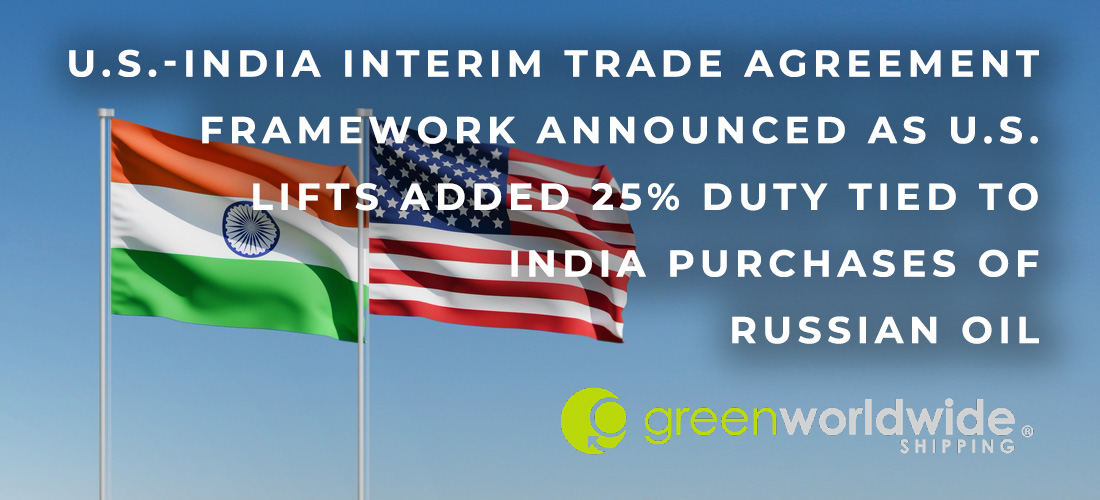
On February 6, 2026, The White House released a U.S.–India joint statement describing a framework for an “Interim Agreement” on reciprocal and mutually beneficial trade, positioned as a step within broader bilateral trade agreement negotiations.
Issued the same day, an executive order removes an additional 25% ad valorem duty that had been applied to imports of articles of India based on findings tied to India’s direct or indirect importing of Russian Federation oil under a prior executive order.
The removal takes effect at 12:01 a.m. EST on February 7, 2026, and is presented in the executive order as reflecting “significant steps” taken by India in relation to the underlying national emergency context described in earlier actions.
U.S.–INDIA BILATERAL TRADE AGREEMENT (BTA)
The joint statement frames the Interim Agreement as a near-term mechanism to advance the broader U.S.–India Bilateral Trade Agreement (BTA) negotiations launched on February 13, 2025. It also lists key elements expected to be included in the Interim Agreement, including tariff changes and new rules intended to govern how benefits apply between the two countries.
In parallel, the executive order terminates specific Chapter 99 provisions that implemented the additional 25% duty on imports of articles of India. This is not described as replacing the broader trade framework; rather, it is a discrete duty action that takes effect on a defined date and is paired with ongoing monitoring provisions.
Effective 12:01 a.m. EST on February 7, 2026, the order states that HTSUS subheadings 9903.01.84 through 9903.01.89 “are hereby terminated,” eliminating the additional 25% duty treatment implemented through those headings. The order also states that where implementation requires refunds of duties collected, refunds will be processed pursuant to applicable law and through the standard procedures of U.S. Customs and Border Protection.
U.S.–INDIA JOINT STATEMENT
The joint statement outlines intended tariff steps on both sides. It states that India will eliminate or reduce tariffs on all U.S. industrial goods and a wide range of U.S. food and agricultural products, and that the United States will apply a reciprocal tariff rate of 18% under cited executive authority on originating goods of India, with examples of covered sectors listed in the statement.
It also states that, subject to successful conclusion of the Interim Agreement, the United States will remove the reciprocal tariff on a wide range of goods, such as generic pharmaceuticals, gems and diamonds, and aircraft parts, identified in the annex.
MONITORING AND THE POSSIBILITY OF FUTURE DUTY ACTION
The executive order directs the U.S. Department of Commerce to monitor whether India resumes directly or indirectly importing Russian Federation oil (as defined in the referenced prior order). It also lays out an interagency recommendation pathway that contemplates potential additional action, including possible reimposition of the additional 25% duty if the monitored condition is found to have occurred.
Stay up-to-date on freight news with Green’s Weekly Freight Market Update by following us on LinkedIn. For continuous updates, make sure to check out our website at greenworldwide.com.