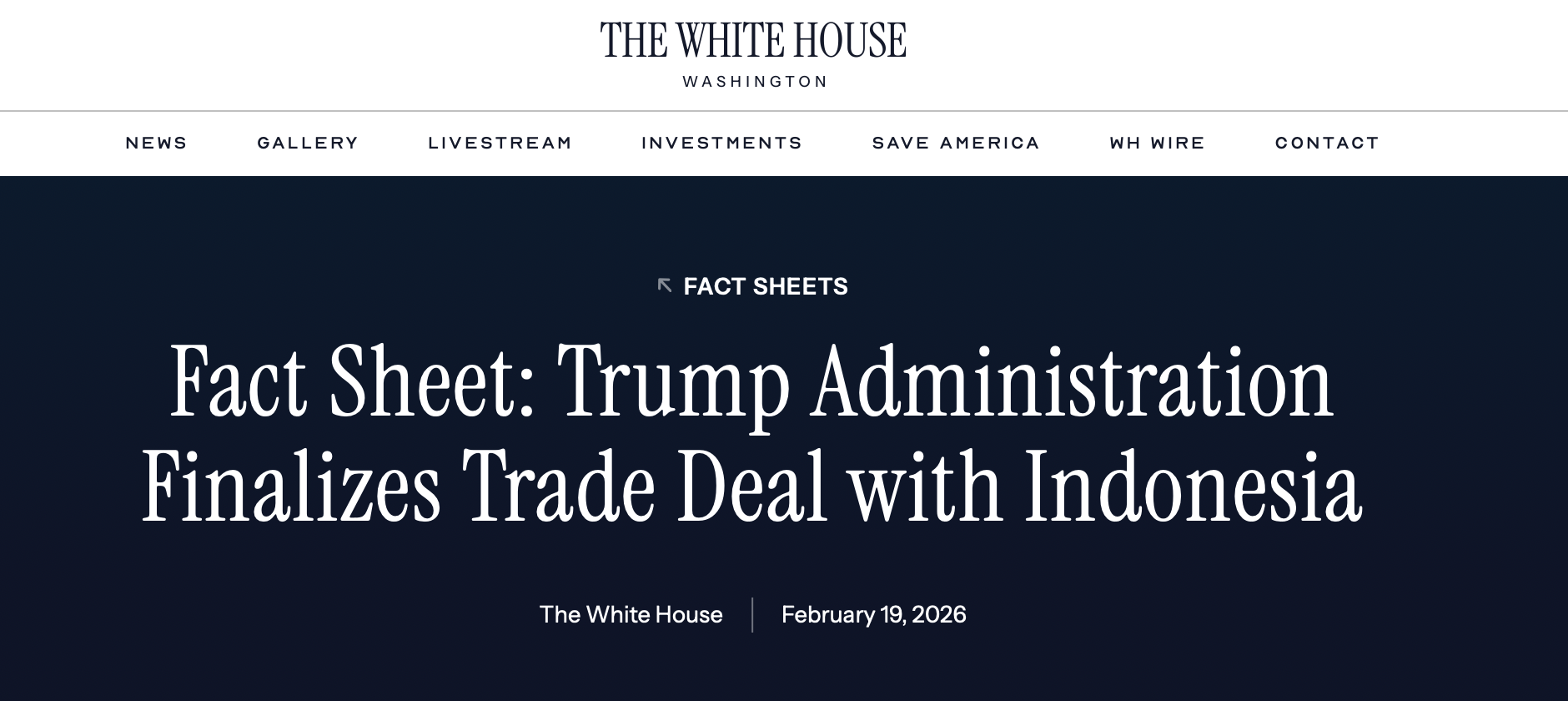
The United States and Indonesia have finalized a bilateral trade agreement that maintains the existing 19% reciprocal tariff on Indonesian goods while creating a new tariff-rate quota (TRQ) for certain Indonesian textile and apparel products.
Under the agreement, qualifying textile and apparel goods from Indonesia will be permitted to enter the United States free of the reciprocal tariff up to a specified quota volume. Once the quota threshold is reached, the 19% reciprocal tariff will apply. The detailed product coverage and quota administration procedures are outlined in the agreement text and accompanying schedules released by the Office of the United States Trade Representative (USTR).
MARKET ACCESS AND ELIMINATING TARIFF BARRIERS
Indonesia has committed to eliminating tariff barriers on more than 99% of U.S. products. The agreement also addresses non-tariff barriers, including commitments by Indonesia to recognize certain U.S. regulatory standards. According to the White House fact sheet,
Indonesia will accept U.S. Food and Drug Administration (FDA) standards and U.S. motor vehicle safety standards for applicable goods, reducing duplicative regulatory requirements.
In addition, Indonesia has agreed to implement a ban on forced labor and to adopt measures described as having an “equivalent restrictive effect” to U.S. tariffs imposed for national security purposes. The agreement states that the United States may consider the agreement’s impact on national security in connection with Section 232 measures.
RECIPROCAL TARIFF STRUCTURE
The 19% reciprocal tariff rate on Indonesia will remain in place outside of the new apparel TRQ. The agreement does not eliminate the reciprocal tariff but modifies its application in the textile and apparel sector through quota-based relief.
The agreement materials published by USTR include product schedules detailing the scope of covered goods and applicable tariff treatment. Importers will need to review these schedules to determine eligibility and compliance requirements under the TRQ structure.
ENTRY INTO FORCE
The agreement will take effect 90 days after the parties exchange written notifications confirming completion of their respective legal procedures, unless an alternative date is mutually agreed.
As implementation approaches, additional guidance is expected regarding quota administration, customs procedures, and documentation requirements for qualifying apparel and textile imports.
SINCE THE SUPREME COURT IEEPA RULING…
For the U.S.–Indonesia agreement specifically, the main impact will be in the broader tariff landscape, potentially affecting how tariff levels are set or revisited going forward, but not an automatic reversal of the terms negotiated in the deal itself.
In practice, this means the apparel TRQ and the 19% negotiated tariff remain part of the agreement as it was laid out, but the context in which those tariff rates are applied and enforced is undergoing legal and administrative change.
Stay up-to-date on freight news with Green’s Weekly Freight Market Update by following us on LinkedIn. For continuous updates, make sure to check out our website at greenworldwide.com.