Court filing outlines affected entry volume, system limitations, staffing burden, and a possible path to a new refund process
READ THE DECLARATION: https://storage.courtlistener.com/recap/gov.uscourts.cit.19346/gov.uscourts.cit.19346.31.0_1.pdf
A declaration filed in the U.S. Court of International Trade (CIT) offers a detailed look at why U.S. Customs and Border Protection (CBP) says it cannot immediately remove and refund tariffs imposed under the International Emergency Economic Powers Act (IEEPA).
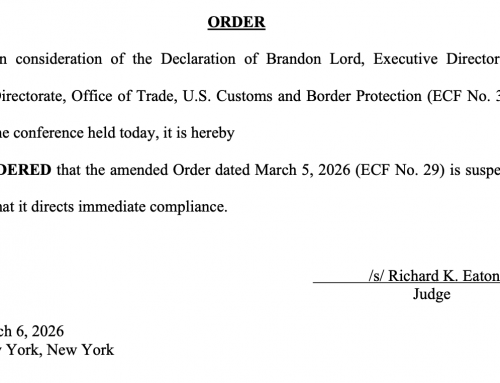
The declaration, submitted by Brandon Lord, Executive Director of the Trade Programs Directorate in CBP’s Office of Trade, explains CBP’s current entry and liquidation framework, the scale of entries tied to IEEPA tariffs , and why the agency says it cannot immediately carry out the court’s directive using its existing systems and processes. CBP states that these concerns apply both to the court’s March 4, 2026 order and to the amended order issued on March 5, 2026.
Those orders directed CBP to liquidate unliquidated IEEPA-subject entries without those tariffs and to reliquidate non-final liquidated entries without them. CBP responds that its current systems and procedures cannot produce that result immediately across the full population of affected entries.
MORE THAN 53 MILLION ENTRIES ARE AT ISSUE
CBP describes the scope of the issue as enormous. As of March 4, 2026, more than 330,000 importers had made more than 53 million entries involving IEEPA tariffs. The agency says it had collected about $166 billion in IEEPA tariffs and estimated duty deposits, while about 20.1 million entries remained unliquidated. CBP frames the matter as a nationwide administrative problem, not a limited correction effort.
ACE LIQUIDATION TIMING IS A CENTRAL OBSTACLE
A large portion of the declaration focuses on ACE liquidation timing. CBP says formal entries automatically liquidate each Friday starting at 2:00 a.m. Eastern Time, and the process runs overnight to avoid slowing cargo operations. More than 700,000 entries were scheduled to liquidate on March 6, 2026, including about 339,000 with IEEPA tariffs. Another roughly 333,000 IEEPA-related entries were scheduled for March 13, 2026.
CBP says that schedule creates an immediate operational problem. According to the declaration, the agency cannot separate IEEPA-subject entries from the scheduled liquidation batch in time to stop only those entries from liquidating. CBP says its alternatives would be to extend liquidation dates manually, one entry at a time, or to reprogram ACE to halt liquidation for all scheduled entries. The agency also states that stopping all scheduled liquidations could cause some entries to miss statutory deadlines and liquidate by operation of law, which in some cases could conflict with AD/CVD instructions or other legal requirements.
The declaration also points to informal entries as a separate issue. CBP says 33,730,325 of the 53,173,939 IEEPA entries, or 63%, are informal entries. It adds that around 4 million informal entries filed before February 24, 2026 had not yet liquidated and that many of them would automatically liquidate on March 16, 2026 when importers pay their March Periodic Monthly Statement. CBP states that it has no process to stop those informal-entry liquidations.
MANUAL REFUND PROCESSING WOULD DEMAND MAJOR STAFFING RESOURCES
CBP also outlines the labor involved if it must rely on current refund procedures. The declaration says importers often combine multiple tariffs on the same entry summary line, which means CBP personnel may need to isolate the IEEPA portion manually before ACE can recalculate the proper amount and issue a refund. CBP adds that its current mass-processing tools can handle only 10,000 entry summary lines per submission and would require about 170,000 separate mass-update actions to address more than 1.68 billion entry summary lines.
The filing further states that once an entry has been reviewed and any manual calculations are complete, an Import Specialist or Entry Specialist needs about five minutes to process a single refund. Using that estimate, CBP calculates that processing refunds for the 53,173,939 affected entries would require 4,431,161 man-hours. CBP says pulling specialists into that work full time would severely disrupt other agency responsibilities, including revenue protection and national security functions. 
ELECTRONIC REFUND SETUP ADDS ANOTHER COMPLICATION
The declaration identifies electronic refund readiness as another barrier. CBP says that as of February 6, 2026, all refunds must be issued electronically. Yet many importers had not completed the required setup. Of the 330,566 importers that paid IEEPA tariffs or duty deposits, only 21,423 had completed the setup process needed to receive refunds electronically. CBP also states that since February 6, it had been unable to process 7,700 refunds for 2,897 importers because those parties had not completed the required steps.
CBP POINTS TO PRIOR REFUND HISTORY FOR CONTEXT
To show how long a large refund effort can take, CBP cites the Harbor Maintenance Fee refund process handled by its predecessor agency after a Supreme Court decision. According to the declaration, that effort took several years and required updated regulatory procedures. CBP uses that example to support its position that a refund program on this scale will require significant time and process changes.
CBP PROPOSES NEW ACE FUNCTIONALITY
Rather than rely only on current procedures, CBP says it believes it can build new ACE functionality to streamline refunds and interest payments on an importer-by-importer basis. Under the process outlined in the declaration, the importer would file a declaration in ACE listing entries on which IEEPA tariffs were paid. ACE would validate the entries, recalculate tariffs without the IEEPA tariffs and with applicable interest, and allow CBP to review the submission. The system would then finalize the entries, aggregate refunds and interest by importer and liquidation date, and support electronic payment by the Department of the Treasury.
CBP estimates that this automated approach would save more than 4 million hours compared with manual processing. The agency also says it is making all possible efforts to have the new ACE functionality ready for use within 45 days.
WHAT THE DECLARATION DOES – AND DOES NOT – RESOLVE
The 45-day timeline described in the declaration applies to building a new processing mechanism, not to completing refunds. Even after that functionality is available, importers would still need to submit declarations identifying the entries on which IEEPA tariffs were paid, and CBP would still need to review and verify those submissions. The declaration therefore suggests that the refund process could remain labor-intensive even under a more automated framework. This is an inference based on the process CBP describes.
The filing also leaves some procedural questions unanswered. One of the most important is whether CBP will be able to reliquidate entries on its own after the 90-day period referenced in 19 U.S.C. § 1501 has expired. The declaration notes that more than 15 million entries had already liquidated with IEEPA tariffs on or before December 4, 2025, placing them beyond that 90-day voluntary reliquidation period as of the court’s March 4, 2026 order. It also identifies additional entries nearing that deadline.
Even with those open questions, the declaration marks a meaningful development because it lays out, in concrete terms, how CBP views the operational burden and how it may try to build a more uniform refund process. At the same time, the declaration does not address several related issues, including pending PSCs, 1520(d) claims, protests, reconciliation entries, FTZ withdrawals involving PF-status goods, processed drawback claims, and tenders submitted through prior disclosures.
Stay up-to-date on freight news with Green’s Weekly Freight Market Update by following us on LinkedIn. For continuous updates, make sure to check out our website at greenworldwide.com.