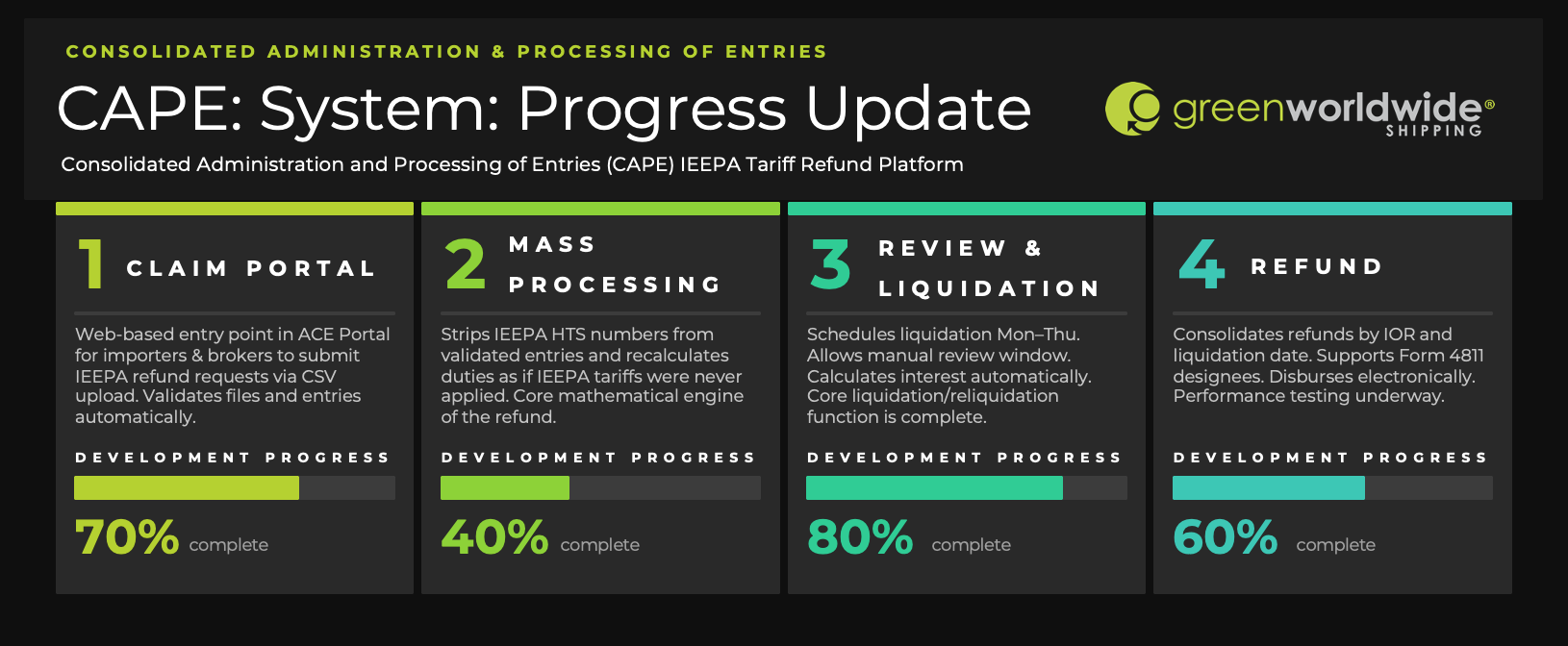
CBP’s automated IEEPA tariff refund platform, CAPE, is now 40–80% complete across its four core components.
The U.S. Court of International Trade (CIT) received a detailed progress report on March 12, 2026, revealing that U.S. Customs and Border Protection (CBP) is making measurable headway in building a fully automated system to refund importers for duties collected under the International Emergency Economic Powers Act (IEEPA).
Senior Judge Richard K. Eaton, presiding over Atmus Filtration, Inc. v. United States (Court No. 26-01259), described CBP’s efforts as satisfactory and maintained his suspension of the order requiring immediate liquidation of IEEPA-affected entries.
The declaration outlines the architecture and current development status of the Consolidated Administration and Processing of Entries (CAPE) system, a new module within the Automated Commercial Environment (ACE) designed to process IEEPA duty refund claims from start to finish.
INSIDE CAPE: A FOUR-COMPONENT REFUND ARCHITECTURE
Brandon Lord, Executive Director, Trade Programs Directorate, CBP, presented their progress to the court on Thursday, March 12, 2026.
CAPE is a purpose-built workflow system comprising four integrated components, each handling a distinct stage of the refund lifecycle.
CLAIM PORTAL: 70% COMPLETE
The Claim Portal is the public-facing gateway through which importers of record (IORs) and their licensed customs brokers will submit IEEPA refund requests, referred to formally as a CAPE Declaration.
The interface will appear as a new tab within existing ACE Portal accounts and will support CSV file uploads listing entry summaries for which IEEPA duty refunds are sought — avoiding the need for Automated Broker Interface (ABI) filing.
The portal conducts two sequential rounds of automated validation upon submission:
- Round One: File-level validation checks formatting integrity, confirming the submitter’s authority and rejecting corrupted CSV files with specific error messages.
- Round Two: Entry-level validation confirms that each listed entry exists in ACE and carries at least one IEEPA HTS Chapter 99 designation.
Entries that fail entry-level validation are individually removed from the declaration, while the remaining entries continue processing.
CBP has completed the Claim Portal’s user interface and is now building the automated validation logic. The component is estimated to be 70% complete.
validation logic. The component is estimated to be 70% complete.
MASS PROCESSING: 40% COMPLETE
Once a CAPE Declaration clears the Claim Portal, the Mass Processing component takes over. It automatically strips the applicable IEEPA Harmonized Tariff Schedule (HTS) numbers from each validated entry summary and reruns ACE’s standard duty calculation process, effectively recalculating what duties would have been owed had IEEPA tariffs never been applied in the first place.
This recalculation is the mathematical backbone of the refund process: it determines the delta between what was paid under IEEPA-inclusive duty rates and what should have been paid without them. CBP estimates that this component is 40% complete, with current development focused on the automated entry summary update process and supporting validations.
REVIEW AND LIQUIDATION/RE-LIQUIDATION: 80% COMPLETE
The most advanced component in CAPE is the Review and Liquidation/Reliquidation module, which is 80% complete.
This segment schedules liquidation or reliquidation of the processed entries and builds in a window for CBP to conduct a manual review if warranted before finalization. The review window’s exact duration was not specified in the filing.
Crucially, this component handles interest calculation, a detail that matters significantly to importers waiting on refunds. It also introduces a departure from CBP’s standard weekly Friday liquidation schedule: CAPE-related liquidations will occur Monday through Thursday, enabling a higher throughput of refund processing.
CBP has completed the core liquidation/re-liquidation functionality and is moving into performance testing, with additional development pending progress on other CAPE components.
REFUND COMPONENT: 60% COMPLETE
The final stage is the Refund component, currently 60% complete. When entries reach their scheduled liquidation or reliquidation date, ACE routes them into a CAPE-specific refund process within the ACE Collections module. Refunds are consolidated by liquidation date and importer of record.
IORs also have the option to designate a third party to receive refunds on their behalf via CBP Form 4811, providing flexibility for brokers, freight forwarders, or financial intermediaries acting on behalf of importers.
Once processed, refunds are disbursed electronically to the designated bank account.
CBP has completed the CAPE-specific refund processing logic within the ACE Collections framework and is now running performance testing on the refund consolidation process. Additional development to fully integrate the Refund component with the other CAPE modules, along with further performance testing, is expected to be completed within the coming weeks.
PHASED ROLLOUT: WHAT IS INCLUDED OR EXCLUDED?
CBP is taking a phased approach to CAPE’s deployment, beginning with foundational functionality and layering in support for more complex scenarios in subsequent releases.
The initial phase is designed to handle the majority of formal and informal entries on which IEEPA duties were paid.
However, certain categories of entries are excluded from Phase 1 processing, including:
- Unliquidated entries subject to antidumping or countervailing duties
- Entries whose liquidation status in ACE is designated as “Suspended,” “Extended,” or “Under Review”
- Warehouse withdrawals and entries designated on a drawback claim
- Certain other specialized entry types
CBP has indicated it will publish detailed user guidance for each phase as capabilities are rolled out.
The agency is also evaluating whether any steps are required to comply with the Paperwork Reduction Act before the Claim Portal can go live for public use — a regulatory step that could affect the final timeline.
Stay up-to-date on freight news with Green’s Weekly Freight Market Update by following us on LinkedIn. For continuous updates, make sure to check out our website at greenworldwide.com.