On February 20, the U.S. Supreme Court ruled that the International Emergency Economic Powers Act (IEEPA) does not grant the president authority to impose tariffs. In a 6–3 decision, the Court concluded that while IEEPA permits the president to “regulate … importation” in response to an unusual or extraordinary threat, the statute does not provide explicit authority to set or adjust tariff rates.
READ THE FULL SUPREME COURT RULING
The case centered on whether IEEPA’s broad grant of power to regulate economic transactions during national emergencies extends to the imposition of customs duties. The majority opinion determined that tariff authority must be clearly stated by Congress. The Court noted that in other trade statutes, Congress has expressly delegated tariff-setting powers, and that the absence of similar language in IEEPA indicates that no such authority was intended under that law.
Because the Supreme Court has ruled that IEEPA does not authorize tariffs:
- That statutory interpretation is now binding precedent.
- There is no higher court to appeal to.
- The executive branch cannot re-litigate that same question.
SUPREME COURT AFFIRMS IEEPA RULING
The Supreme Court affirmed the decision of the U.S. Court of Appeals for the Federal Circuit, which had previously addressed the scope of presidential authority under IEEPA. The case will now return to the U.S. Court of International Trade to consider whether a nationwide injunction against tariffs imposed under IEEPA is appropriate.
The case has been remanded to the U.S. Court of International Trade.
That court must now determine:
- Whether to issue a nationwide injunction blocking tariffs imposed under IEEPA
- The scope and structure of any relief
- Whether refunds or other remedies are appropriate
The Supreme Court did not resolve the injunction question; it sent that issue back for further consideration.
IEEPA CAN NO LONGER BE USED AS A TARIFF TOOL
The ruling narrows the executive branch’s use of IEEPA in trade policy and reinforces the requirement that tariff authority originate from explicit congressional authorization. Other statutory mechanisms for imposing trade remedies, such as Section 232 of the Trade Expansion Act of 1962 and Section 301 of the Trade Act of 1974, remain unaffected by the decision.
The ruling does not affect all tariffs imposed by the administration. Specifically:
- Tariffs on steel and aluminum implemented under separate statutory authorities remain in place.
However, the decision invalidates two categories of tariffs that relied on IEEPA authority:
- Country-by-country “reciprocal” tariffs, which ranged from 34% on China to a 10% baseline rate applied more broadly.
- A 25% tariff on certain goods from Canada, China, and Mexico, which had been imposed in connection with concerns over fentanyl flows.
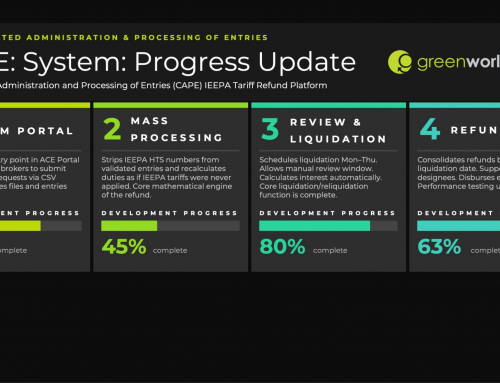
The Court of International Trade should provide guidance on whether importers are entitled to refunds, the procedural mechanism for claiming them, and the timing of any repayment.
Stay up-to-date on freight news with Green’s Weekly Freight Market Update by following us on LinkedIn. For continuous updates, make sure to check out our website at greenworldwide.com.