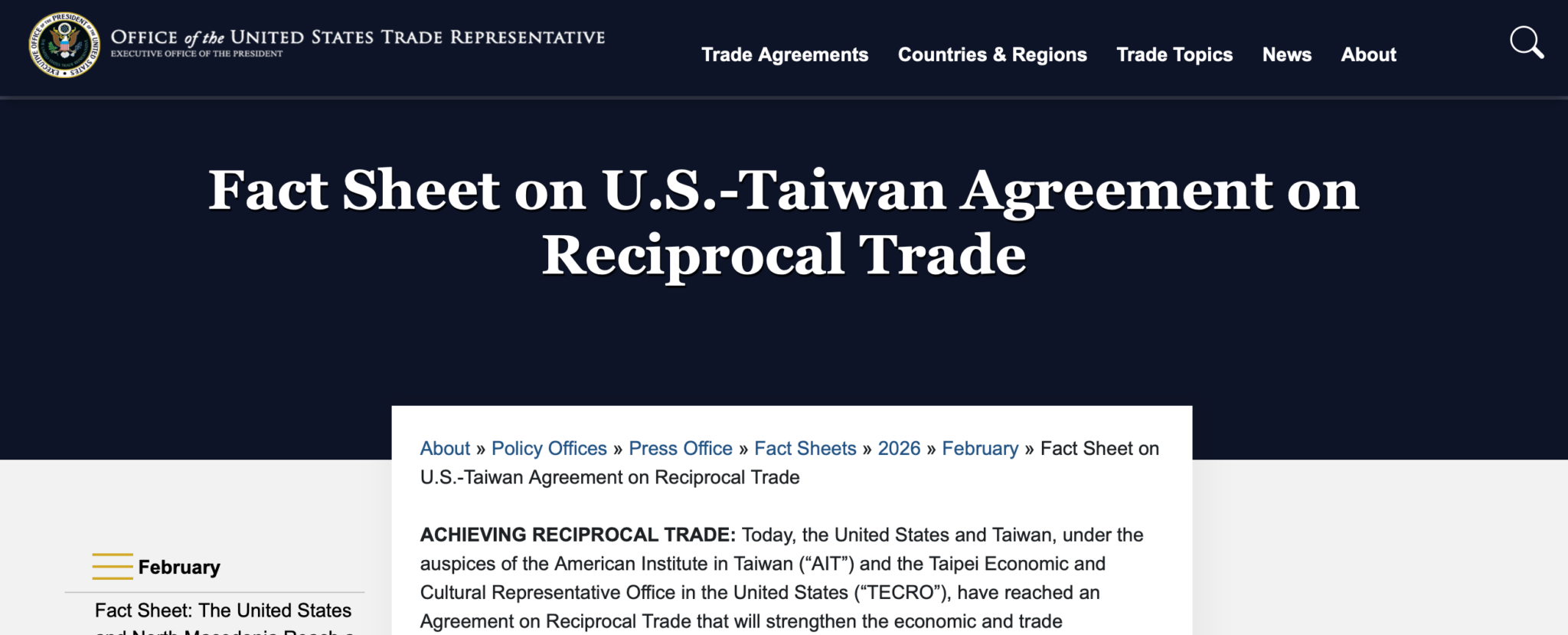
A new reciprocal trade agreement between the United States and Taiwan, signed on February 12, 2026, establishes a unified 15 percent all‑in tariff framework for most Taiwanese goods while significantly expanding market access in both directions. Originally announced back in January, the accord is positioned as part of a broader strategy to align trade policy with economic and national security priorities across advanced manufacturing and technology sectors.
The agreement will take effect the day after both sides complete their respective internal procedures and formally notify each other, including a review by the legislature on the Taiwan side. Officials describe the deal as the final step following a memorandum of understanding signed in January that outlined the basic terms of the reciprocal trade package.
15 PERCENT ALL‑IN TARIFF STRUCTURE
At the center of the deal is a 15 percent all‑in tariff benchmark applied on a reciprocal basis to most traded goods. For Taiwan‑origin products currently facing a most‑favored nation (MFN) rate below 15 percent, the total duty will be adjusted so that the combined MFN and reciprocal component does not exceed that level.
Goods with MFN tariffs above 15 percent will generally be subject to reciprocal tariffs. Taiwanese products that are exempt from reciprocal tariffs, including agricultural goods previously excluded under earlier actions and additional items drawn from a prior list of potential tariff adjustments for aligned partners are listed in the agreement annex.
SECTION 232 TREATMENT AND REMEDIAL MEASURES
Earlier U.S. statements indicated that certain Taiwanese auto parts and lumber‑related products covered by Section 232 tariffs would also be brought under the 15 percent rate, but the final agreement adopts more cautious language. Rather than specifying individual product outcomes, it states that implementation of the agreement will be taken into account when considering tariffs, export controls, investment‑screening measures, and related tools.
According to an official fact sheet, Taiwan is set to receive preferential treatment in the Section 232 investigation into semiconductors and semiconductor manufacturing equipment, as well as in certain other Section 232 proceedings.
EXPANDED ACCESS TO TAIWAN MARKETS
Taiwan has committed to eliminate or reduce tariff barriers on about 99 percent of U.S. goods, substantially widening opportunities for exporters. The agreement promises preferential market access for a broad slate of industrial products, including autos and auto parts, chemicals, seafood, machinery, health products, electrical equipment, metals, and minerals.
In agriculture, Taiwan will open or further liberalize trade in horticultural products, wheat, beef and beef products, dairy products, pork and pork products, lamb and sheep meat, tree nuts, dog and cat food, ketchup, and peanuts, among others.
REDUCING NON‑TARIFF BARRIERS FOR KEY U.S. INDUSTRIES
Beyond tariff cuts, the agreement addresses several long‑standing non‑tariff barriers. Taiwan will accept motor vehicles built to U.S. federal safety standards, a shift expected to reduce overlapping testing requirements and technical hurdles for exporters.
In pharmaceuticals and medical devices, Taiwan will recognize U.S. Food and Drug Administration marketing authorizations, streamlining regulatory approvals and shortening time‑to‑market for U.S. products. Additional provisions cover intellectual property protection, labor standards, and environmental commitments, aiming to provide a more predictable environment for long‑term investment and supply‑chain planning.
SEMICONDUCTOR INVESTMENT AND SUPPLY‑CHAIN COOPERATION
A prominent feature of the accord is its explicit focus on semiconductor and high‑tech supply chains. Taiwan commits to increasing investment in U.S. semiconductor production, building on a January memorandum that references the creation of industrial parks in the United States for semiconductors, electronics manufacturing services, including artificial intelligence applications, and energy sectors.
The agreement highlights plans to “significantly” expand investment across the semiconductor supply chain and related high‑tech manufacturing, reinforcing the United States as a production hub for critical technologies.
COORDINATED IMPORT RESTRICTIONS ON OTHER COUNTRIES
One provision requires Taiwan to align with future U.S. measures against third‑country imports. If the United States imposes a tariff or other import restriction on a product from another country, Taiwan must regulate imports of that product through measures with an equivalent restrictive effect.
The clause effectively formalizes coordination on trade actions targeting third parties and is likely to be closely watched by supply‑chain planners and compliance teams.
Stay up-to-date on freight news with Green’s Weekly Freight Market Update by following us on LinkedIn. For continuous updates, make sure to check out our website at greenworldwide.com.