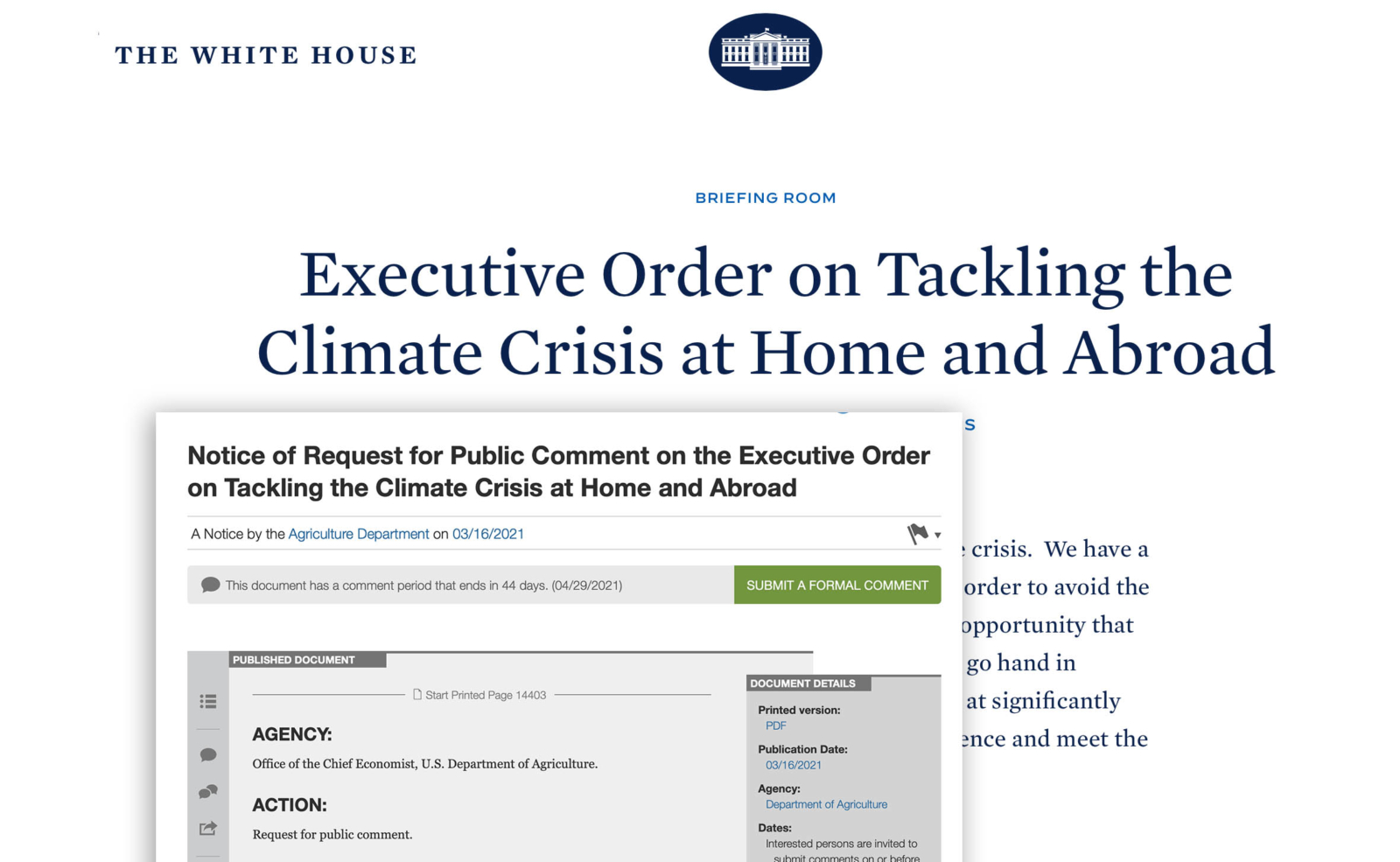
On January 27, 2021, United States President Biden issued an Executive Order on Tackling the Climate Crisis at Home and Abroad. The Executive Order laid out a series of actions for Federal Agencies to take regarding climate change mitigation and resilience, including directing the Secretary of Agriculture to collect stakeholder input on a climate-smart agriculture and forestry strategy.
“The United States and the world face a profound climate crisis. We have a narrow moment to pursue action at home and abroad in order to avoid the most catastrophic impacts of that crisis and to seize the opportunity that tackling climate change presents. Domestic action must go hand in hand with United States international leadership, aimed at significantly enhancing global action. Together, we must listen to science and meet the moment.”
WHITE HOUSE: Executive Order on Tackling the Climate Crisis at Home and Abroad
As part of this process, on March 16, 2021, the U.S. Department of Agriculture (USDA) issued a Federal Register Notice requesting public input “on how to best use Department of Agriculture programs, funding and financing capacities, and other authorities, and how to encourage the voluntary adoption of climate-smart agricultural and forestry practices that decrease wildfire risk fueled by climate change and result in additional, measurable, and verifiable carbon reductions and sequestration and that source sustainable bioproducts and fuels.”
In the notice, the USDA included a 4-part questionnaire in order to address the specific feedback the White House directive presented to the agency:
Climate-Smart Agriculture and Forestry Questions
- How should USDA utilize programs, funding and financing capacities, and other authorities, to encourage the voluntary adoption of climate-smart agricultural and forestry practices on working farms, ranches, and forest lands?
- How can USDA leverage existing policies and programs to encourage voluntary adoption of agricultural practices that sequester carbon, reduce greenhouse gas emissions, and ensure resiliency to climate change?
- What new strategies should USDA explore to encourage voluntary adoption of climate-smart agriculture and forestry practices?
- How can partners and stakeholders, including State, local and Tribal governments and the private sector, work with USDA in advancing climate-smart agricultural and forestry practices?
- How can USDA help support emerging markets for carbon and greenhouse gases where agriculture and forestry can supply carbon benefits?
- What data, tools, and research are needed for USDA to effectively carry out climate-smart agriculture and forestry strategies?
- How can USDA encourage the voluntary adoption of climate-smart agricultural and forestry practices in an efficient way, where the benefits accrue to producers?
Biofuels, Wood and Other Bioproducts, and Renewable Energy Questions
- How should USDA utilize programs, funding and financing capacities, and other authorities to encourage greater use of biofuels for transportation, sustainable bioproducts (including wood products), and renewable energy?
- How can incorporating climate-smart agriculture and forestry into biofuel and bioproducts feedstock production systems support rural economies and green jobs?
- How can USDA support adoption and production of other renewable energy technologies in rural America, such as renewable natural gas from livestock, biomass power, solar, and wind?
Addressing Catastrophic Wildfire Questions
- How should USDA utilize programs, funding and financing capacities, and other authorities to decrease wildfire risk fueled by climate change?
- How can the various USDA agencies work more cohesively across programs to advance climate-smart forestry practices and reduce the risk of wildfire on all lands?
- What additional data, tools and research are needed for USDA to effectively reduce wildfire risk and manage Federal lands for carbon?
- What role should partners and stakeholders play, including State, local and Tribal governments, related to addressing wildfires?
Environmental Justice and Disadvantaged Communities Questions
- How can USDA ensure that programs, funding and financing capacities, and other authorities used to advance climate-smart agriculture and forestry practices are available to all landowners, producers, and communities?
- How can USDA provide technical assistance, outreach, and other assistance necessary to ensure that all producers, landowners, and communities can participate in USDA programs, funding, and other authorities related to climate-smart agriculture and forestry practices?
- How can USDA ensure that programs, funding and financing capabilities, and other authorities related to climate-smart agriculture and forestry practices are implemented equitably?
DATES
Interested persons are invited to submit comments on or before 11:59 p.m. Eastern Time April 29, 2021.
SUBMISSIONS
- Go to the Federal eRulemaking Portal: https://www.regulations.gov
- Search for Docket No. USDA-2021-0003
- Follow the online instructions for submitting comments
- Please provide information including citations and/or contact details for the correspondent when submitting comments.
Note: All comments received will be posted without change and publicly available on www.regulations.gov.
As Green continues to monitor the situation, stay up-to-date on freight news by following us on Facebook, Twitter, and LinkedIn. For continuous updates, make sure to check out our website at greenworldwide.com.