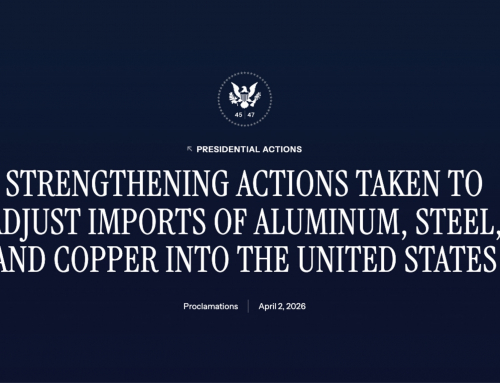

The United States Trade Representative (USTR) published a new trade action under Section 301 of the Trade Act of 1974 concerning structural excess capacity and production across global manufacturing sectors. The investigations will examine whether policies or practices in certain jurisdictions contribute to excess industrial output that burdens or restricts U.S. commerce.
At this stage, the action places these sectors under formal review. No tariffs, quotas, or other trade restrictions are being implemented in connection with this action.
The investigations apply to the following countries: China, Singapore, Switzerland, Norway, Indonesia, Malaysia, Cambodia, Thailand, Korea, Vietnam, Taiwan, Bangladesh, Mexico, Japan, and India, as well as the European Union.
WHICH MANUFACTURING INDUSTRIES ARE IDENTIFIED IN THE SECTION 301 INVESTIGATION?
The Federal Register notice indicates that structural excess capacity concerns may affect a wide range of global manufacturing industries.
The sectors identified in the notice include:
| Aluminum | Glass | Robotics |
| Automobiles | Machine Tools | Satellites |
| Batteries | Machinery | Semiconductors |
| Cement | Non-Ferrous Metals | Ships |
| Chemicals | Paper | Solar Modules |
| Electronics | Plastics | Steel |
| Energy Goods | Processed Food & Beverages | Transportation Equipment |
The notice describes this list as illustrative. The investigation may evaluate additional sectors as the review proceeds.
WHAT IS EXCESS CAPACITY?
Excess capacity occurs when manufacturing industries have the ability to produce more goods than global markets can absorb. When production capacity exceeds demand, factories operate below normal utilization levels and surplus output may be exported to international markets.
In the Section 301 investigation notice, USTR indicates that sustained excess capacity may signal that production is expanding faster than consumption. These conditions can contribute to persistent trade surpluses, lower global prices, and increased competitive pressure on domestic industries.