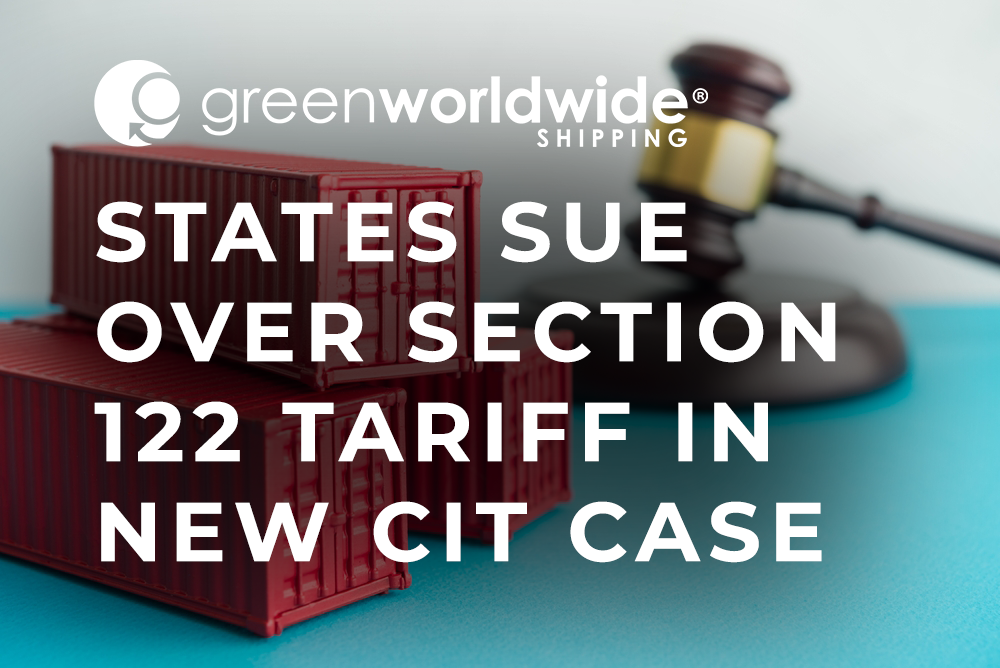
A coalition of U.S. states has filed a complaint in the U.S. Court of International Trade challenging the federal government’s use of Section 122 of the Trade Act of 1974 (19 U.S.C. § 2132) to impose a 10% tariff on most products worldwide, along with related implementation actions by U.S. Customs and Border Protection (CBP).
READ THE CIT FILING: https://storage.courtlistener.com/recap/gov.uscourts.cit.19559/gov.uscourts.cit.19559.2.0_1.pdf
STATES INVOLVED
Oregon, Arizona, California, New York, Colorado, Connecticut, Delaware, Illinois, Kentucky, Maine, Maryland, Massachusetts, Michigan, Minnesota, Nevada, New Jersey, New Mexico, North Carolina, Pennsylvania, Rhode Island, Vermont, Virginia, Washington, and Wisconsin.
WHAT IS BEING CHALLENGED
According to the complaint, after the Supreme Court ruled that IEEPA does not authorize the imposition of tariffs, the President issued a proclamation invoking Section 122 and imposed a 10% worldwide tariff that took effect February 24, 2026.
THE KEY LEGAL ARGUMENTS
The states’ complaint frames the dispute primarily as a statutory authority and constitutional separation-of-powers issue:
1) Section 122’s prerequisites and purpose
The complaint asserts Section 122 is intended for limited circumstances tied to “fundamental international payments problems” and “large and serious balance-of-payments deficits,” and argues those statutory conditions are not satisfied by the proclamation’s stated rationale.
2) Trade deficit vs. balance of payments
The complaint argues that the proclamation improperly treats trade deficits as equivalent to a balance-of-payments deficit, and emphasizes that Section 122 differentiates between “balance of payments” and “balance of trade.”
3) Broad and uniform application / nondiscriminatory treatment
The complaint points to statutory language requiring tariffs to be applied consistently with non-discriminatory treatment and to be broad and uniform in product coverage (subject to narrow exceptions), while alleging the proclamation contains substantial country and product exceptions.
RELIEF REQUESTED (WHAT THE STATES WANT THE COURT TO DO):
- Declare the proclamation unlawful.
- Stop enforcement of the proclamation and set aside CBP’s implementing guidance.
- Order refunds of Section 122 duties collected on covered entries where the states (or their instrumentalities) are the importer of record, with interest as provided by law.
Stay up-to-date on freight news with Green’s Weekly Freight Market Update by following us on LinkedIn. For continuous updates, make sure to check out our website at greenworldwide.com.