
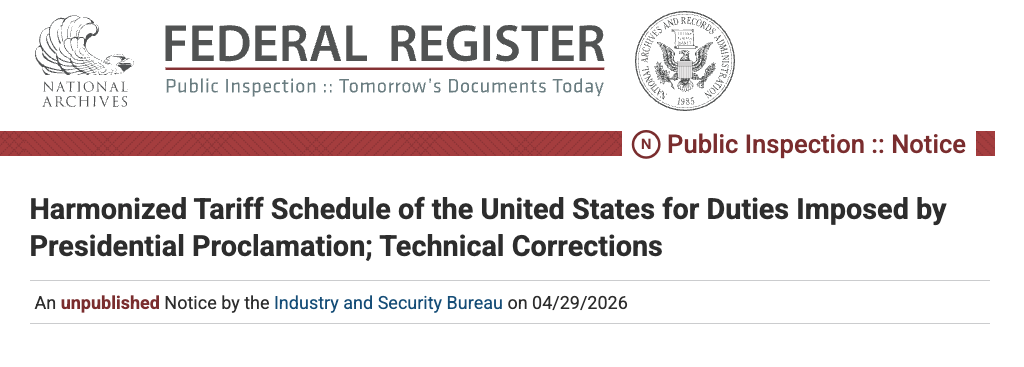
The U.S. Department of Commerce, Bureau of Industry and Security (BIS), has issued an unpublished notice introducing technical corrections and a clarification to the Harmonized Tariff Schedule of the United States (HTSUS) following the Administration’s April 2, 2026 proclamation on aluminum, steel, and copper imports. These updates refine how certain products are classified and ensure alignment between tariff applicability and product composition.
The corrections apply to goods entered for consumption, or withdrawn from warehouse for consumption, on or after 12:01 a.m. Eastern Time on April 6, 2026.
WHAT CHANGES WERE MADE TO HTSUS CHAPTER 99?
The notice introduces two technical corrections to Annex IV and provides a clarification related to tariff applicability under Chapter 99.
The first correction adds a new HTSUS subheading, 9903.82.01. This subheading is specifically designated for products that fall under the listed tariff provisions in U.S. Note 16 but do not actually contain aluminum, steel, or copper. These products are now explicitly excluded from the additional duties imposed under the proclamation and must be reported using the new classification.
HOW DOES THE CORRECTION IMPACT U.S. NOTE 16 INTERPRETATION?
The second correction addresses an inconsistency within part (e) of U.S. Note 16. The original language created ambiguity in how certain subdivisions were referenced and applied. To resolve this, BIS removed the second paragraph of subpart (e), aligning the provision with its intended scope. This correction ensures consistency between the narrative language and the referenced tariff headings, particularly for products classified under Heading 9903.82.06. This adjustment is technical in nature but directly affects how filers interpret eligibility and apply tariff provisions within Chapter 99.
WHAT CLARIFICATION WAS PROVIDED FOR U.K.-ORIGIN STEEL?
The notice also confirms continued eligibility for a specific category of U.K.-origin steel products. Steel articles produced by Tata Steel UK that include melt and pour activity reported in the Netherlands may continue to qualify for the lower Section 232 tariff rate applicable to U.K.-origin steel. This treatment remains valid through January 1, 2028. In addition, these products may continue to count toward the 95 percent melt and pour requirement under U.S. Note 16(d) for applicable tariff headings during this period.
WHAT SHOULD IMPORTERS AND FILERS REVIEW FOLLOWING THESE UPDATES?
Importers and customs filers should review how their products align with U.S. Note 16 and the updated Chapter 99 provisions.
Key areas for evaluation include:
• Whether any products previously captured under derivative tariff provisions now qualify for exclusion under subheading 9903.82.01
• Alignment between product composition and declared HTSUS classification
• Application of corrected Note 16 language to ensure consistent tariff treatment
• Eligibility for continued preferential treatment under U.K.-origin steel provisions where applicable
These technical corrections do not introduce new tariff measures but directly impact classification accuracy and duty applicability under the current Section 232 framework.
Stay up-to-date on freight news with Green’s Weekly Freight Market Update by following us on LinkedIn. For continuous updates, make sure to check out our website at greenworldwide.com.