

Ocean freight markets are showing a change in direction as Asia–Europe rates increase after several months of declines. At the same time, carriers have announced more blank sailings, and new reliability data indicates that importers moving cargo from Asia to North America continue to face significant uncertainty around vessel arrivals and available bookings.
Additional scheduled container capacity is returning to Red Sea routes, while cross-border trucking conditions are changing along the U.S.–Mexico trade corridor. Air cargo rates remain elevated despite a slowdown in weekly volumes, and new security measures have been announced following attacks on commercial shipping in the Black Sea.
MARKET SUMMARY OVERVIEW
Drewry's World Container Index increased 3% for the week ending October 15, reversing three consecutive weeks of declines.
Asia–Europe routes recorded the largest increases. Shanghai–Rotterdam rose 6%, while Shanghai–Genoa increased 7%. Both routes recorded their first weekly gains following thirteen consecutive weeks of declining rates.
Trans-Pacific pricing was mixed. Shanghai–Los Angeles increased 3%, while Shanghai–New York declined 1%.
Intra-Asia rates continued lower, with Drewry's Intra-Asia Container Index declining 3% following a 1% decrease the previous week.
The latest movements show a divergence between major trade lanes. While Asia–Europe pricing has begun recovering, additional capacity and changing cargo demand continue to influence the sustainability of announced rate increases.
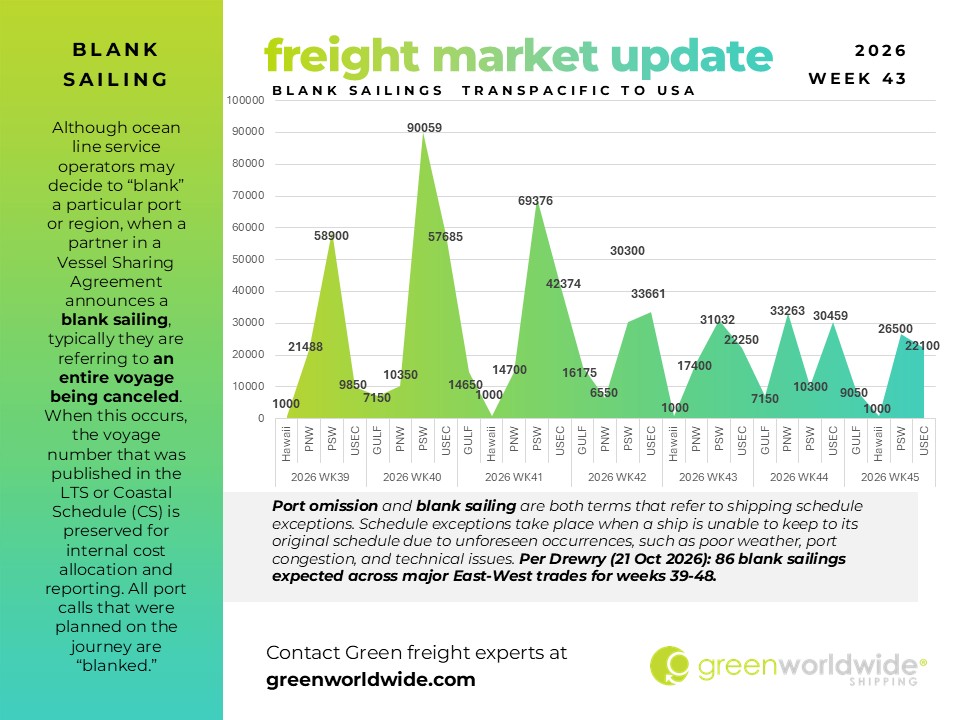
BLANK SAILINGS INCREASE ACROSS MAJOR EAST–WEST TRADES
Ocean carriers have announced additional sailing cancellations as capacity adjustments continue across the major East–West trade lanes.
Drewry's October 16 Cancelled Sailings Tracker identifies 44 blank sailings across Weeks 43 through 47 out of 713 planned sailings. The cancellations represent approximately 6% of scheduled voyages, with 94% currently expected to operate.
The latest assessment compares with 34 announced cancellations out of 713 scheduled sailings in the previous reporting period.
Asia–North Europe and Mediterranean routes account for 44% of planned cancellations, followed by the Trans-Pacific eastbound trade at 36% and the Transatlantic at 20%.
The increase in canceled sailings comes as carriers manage changing demand and vessel availability following Golden Week. Meanwhile, additional services returning through the Suez Canal are affecting effective capacity on Asia–Europe trades.
Although most scheduled voyages are expected to operate, individual cancellations may affect available departure options and planned cargo connections.
Importers should continue confirming sailing schedules, cargo cutoffs and available capacity before finalizing time sensitive shipments.
TRANS-PACIFIC SCHEDULE RELIABILITY FALLS BELOW 27%
New ocean freight reliability data shows continued challenges for importers moving cargo between Asia and North America.
According to WiseTech Global's October Ocean Freight Risk Outlook, on-time performance across Asia–North America services declined to 26.9% in September, compared with 33.9% in August.
The latest weekly reading remained weak at 26.8%, with delays of eight days or more representing the largest late-arrival category.
WiseTech also expects booking conditions to become more difficult toward the end of its four-week outlook period as planned vessel capacity declines. The tightening is attributed to reductions in scheduled capacity rather than an anticipated increase in demand.
Conditions on other major routes differ. Asia–Europe on-time performance declined to 9.9% in September, compared with 22.9% in August, although planned vessel capacity remains above forecast demand.
The findings highlight the difference between available vessel space and reliable cargo delivery. A shipment may secure a booking while still facing extended delays at origin, during transit or upon arrival.
Importers with time sensitive cargo should review carrier specific performance, confirmed allocations and expected arrival dates when coordinating delivery schedules.
RED SEA CONTAINER CAPACITY DOUBLES AS MORE SERVICES RETURN
More scheduled container services are returning to Red Sea routes, introducing additional capacity into global shipping networks.
According to Xeneta's October 16 market update, weekly scheduled container capacity crossing the Bab el-Mandeb Strait reached 448,273 TEUs on October 5.
That represents approximately 48% of the 930,679 TEUs of weekly capacity offered in August 2023, before widespread diversions around the Cape of Good Hope.
Scheduled capacity has also doubled since August 27, 2026, reflecting an acceleration in the return of container services to the region.
The shorter Red Sea and Suez Canal routing reduces the distance traveled between Asia and Europe compared with voyages around southern Africa. As more services return, the shorter transit cycle can release vessel capacity back into the wider shipping network.
However, the additional capacity may not immediately translate into more reliable schedules or lower freight costs. Service changes, congestion and regional security conditions continue to influence how carriers deploy vessels.
Importers should confirm actual vessel routing and transit times when booking Asia–Europe shipments, particularly as services transition between the Suez Canal and Cape of Good Hope.
U.S.–MEXICO TRUCKING OPERATIONS FACE CHANGING CAPACITY CONDITIONS
U.S.–Mexico trade continues to expand as transportation providers report changes in cross-border truck capacity and driver availability.
According to U.S. Census Bureau figures, bilateral trade reached approximately $94.3 billion in August, increasing 26.75% compared with the previous year.
Trade between the two countries totaled approximately $682.8 billion through the first eight months of 2026, up 17.5% year-over-year.
Port Laredo remained the busiest U.S. international trade gateway, handling approximately $38.6 billion in bilateral commerce during August.
At the same time, transportation industry reporting indicates that enforcement of commercial driver requirements, including English-language proficiency and cabotage restrictions, is affecting driver availability for certain cross-border operations.
Some transportation providers are reporting greater interest in transloading, where cargo is transferred between equipment or carriers at or near the border before continuing to its final destination.
Transloading can provide an alternative transportation arrangement for qualifying shipments, although its suitability depends on cargo requirements, available facilities and the specific trade lane.
Conditions continue to vary by border crossing and transportation provider. Shippers moving freight between the United States and Mexico should review carrier availability, border processing requirements and shipment-specific transportation options as trade volumes remain elevated.
GLOBAL AIR CARGO RATES REMAIN STEADY AS VOLUMES SOFTEN
Global air cargo pricing remained stable during Week 41 despite another decline in weekly shipment volumes, according to WorldACD's October 19 market report.
Worldwide chargeable weight declined 1% week-over-week, marking the third consecutive weekly decrease. The slowdown was influenced primarily by early-October holidays across China and other Asian markets.
Despite the recent weekly declines, global tonnage remained 9% above the same period last year.
Average worldwide spot rates held at $3.55 per kilogram, while full-market average rates, combining spot and contract pricing, remained unchanged at $3.13 per kilogram.
Asia-Pacific origin spot rates declined 3% week-over-week to $4.83 per kilogram. Across Weeks 40 and 41 combined, Asia-Pacific cargo volumes were 7% below the preceding two-week period.
Regional transportation conditions are also affecting air service availability. Recent attacks involving airport infrastructure in Saudi Arabia have disrupted passenger flight operations, creating additional uncertainty for air cargo moving through affected connections.
The combination of stable global pricing, softer weekly demand and localized transportation disruption reinforces the importance of reviewing air cargo availability by origin, destination and carrier rather than relying solely on global rate averages.
Shippers with time sensitive shipments should continue confirming available capacity, transit options and current operating conditions, particularly for cargo moving through Middle East-connected services.
NATO EXPANDS BLACK SEA MONITORING FOLLOWING COMMERCIAL VESSEL ATTACKS
NATO announced additional maritime surveillance measures on October 20 following a series of attacks involving commercial vessels near Romania and Bulgaria.
The measures include additional maritime patrol aircraft, radar capabilities and drones to strengthen monitoring of activity across the Black Sea.
The announcement follows multiple incidents involving commercial vessels operating near the western Black Sea, including attacks on chemical tankers near Romania's coastline.
According to Reuters, the attacks have resulted in missing crew members and additional concerns about the safety of commercial shipping in waters near NATO member countries.
The new measures represent an increased regional security response but do not establish that commercial shipping risks have been eliminated or that vessel operations have returned to normal.
Shippers moving cargo through affected Black Sea corridors should continue reviewing carrier acceptance, available vessel routing and marine insurance requirements as conditions develop.
Stay up-to-date on freight news with Green’s Weekly Freight Market Update by following us on LinkedIn. For continuous updates, make sure to check out our website at greenworldwide.com.