
Ocean spot rates continued to ease this week as demand softened and port congestion improved at several major Chinese gateways. U.S. import volumes, however, remain elevated following an extended peak season, while global container trade continues to show year-over-year growth.
Blank sailings across the major East-West trades have declined, increasing effective capacity as the market moves toward year-end. Labor negotiations at the Ports of Los Angeles and Long Beach have also been extended through November 20, while air cargo pricing continues to strengthen during the fourth quarter peak. In the Middle East, new attacks on commercial vessels underscore continued security risks in and around the Strait of Hormuz.
MARKET SUMMARY OVERVIEW
Drewry's World Container Index declined 1% for the week of November 5.
Shanghai-to-New York rates fell 3%, while Shanghai-to-Los Angeles remained unchanged.
On Asia-Europe trades, Shanghai-to-Rotterdam declined 2%, while Shanghai-to-Genoa remained relatively stable.
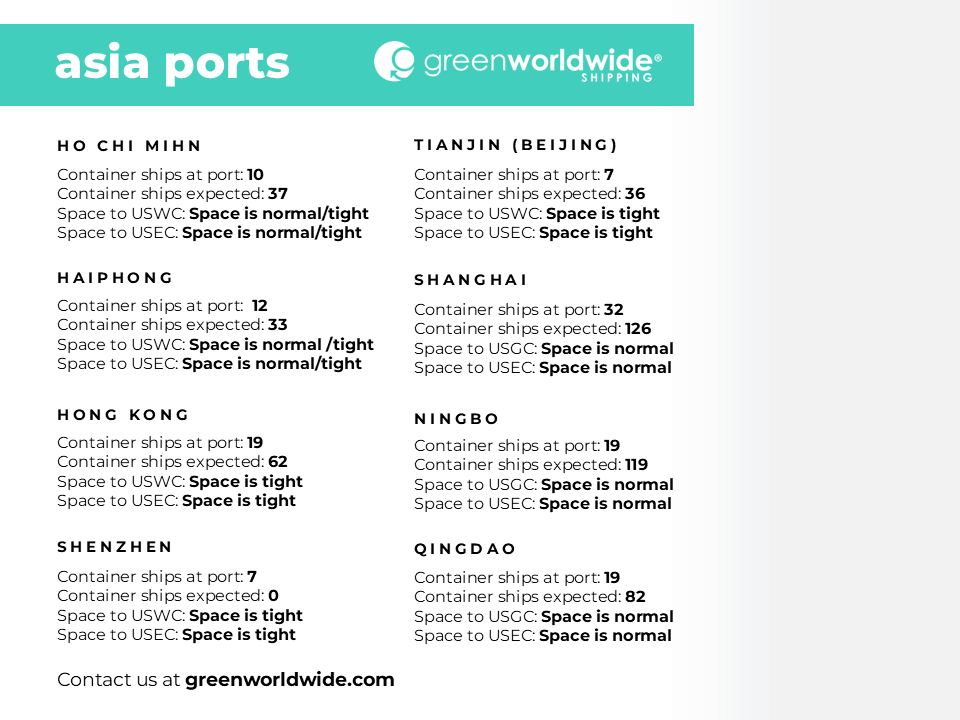
Drewry reported improving port conditions at major Chinese gateways as weather conditions improved and demand softened. Average vessel waiting time at Shanghai declined to approximately 35 hours.
With fewer blank sailings also increasing effective capacity, Drewry expects additional downward pressure on Trans-Pacific rates in the near term.
U.S. IMPORT VOLUMES REMAIN ELEVATED AS PEAK SEASON WINDS DOWN
U.S. imports remained strong through September following an extended peak season.
Ports tracked by the National Retail Federation's Global Port Tracker handled 2.37 million TEUs of loaded imports in September, up 3.4% from August and 12.6% from the same month last year.
September was the busiest import month of 2026 and the third busiest month recorded since Global Port Tracker began tracking volumes.
October imports are estimated at 2.26 million TEUs, while November and December are forecast at approximately 2.05 million and 2.03 million TEUs respectively.
Global Port Tracker currently projects approximately 26 million TEUs of imports for 2026, up 2% from 2025.
The forecast points to softer volumes through year end following a prolonged period of elevated import activity.
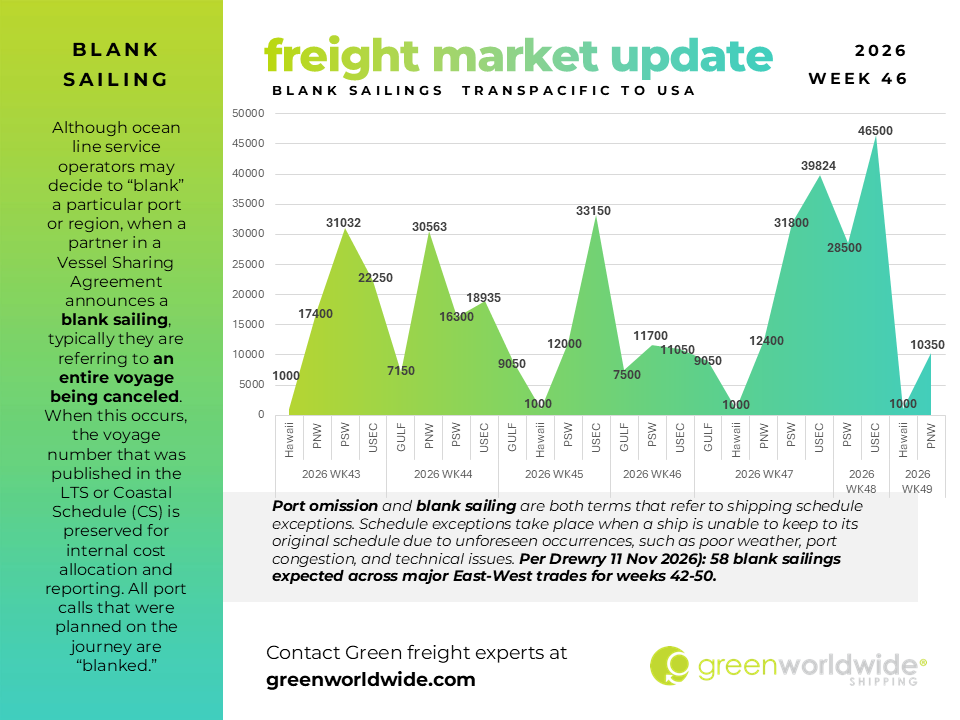
BLANK SAILINGS DECLINE TO 6% ACROSS MAJOR EAST-WEST TRADES
Drewry expects 46 blank sailings out of 717 scheduled voyages across Weeks 46 through 50, representing a 6% cancellation rate.
Asia-North Europe and Mediterranean services account for 50% of announced cancellations, followed by Trans-Pacific eastbound services at 35% and Transatlantic services at 15%.
Approximately 94% of scheduled sailings are expected to operate.
The cancellation rate is down from 8% last week, when 56 of 715 scheduled voyages were expected to be blanked.
Fewer cancellations are increasing effective capacity at a time when demand is beginning to ease across several major East-West trades.
LA/LB LABOR TALKS EXTENDED THROUGH NOVEMBER 20
Labor negotiations involving marine terminal watchmen at the Ports of Los Angeles and Long Beach have been extended through November 20.
The Pacific Maritime Association and ILWU Local 26 agreed to continue the current contract while additional negotiations take place.
Local 26 represents approximately 250 marine terminal watchmen working across the San Pedro Bay port complex.
No strike has been announced, and terminal operations continue.
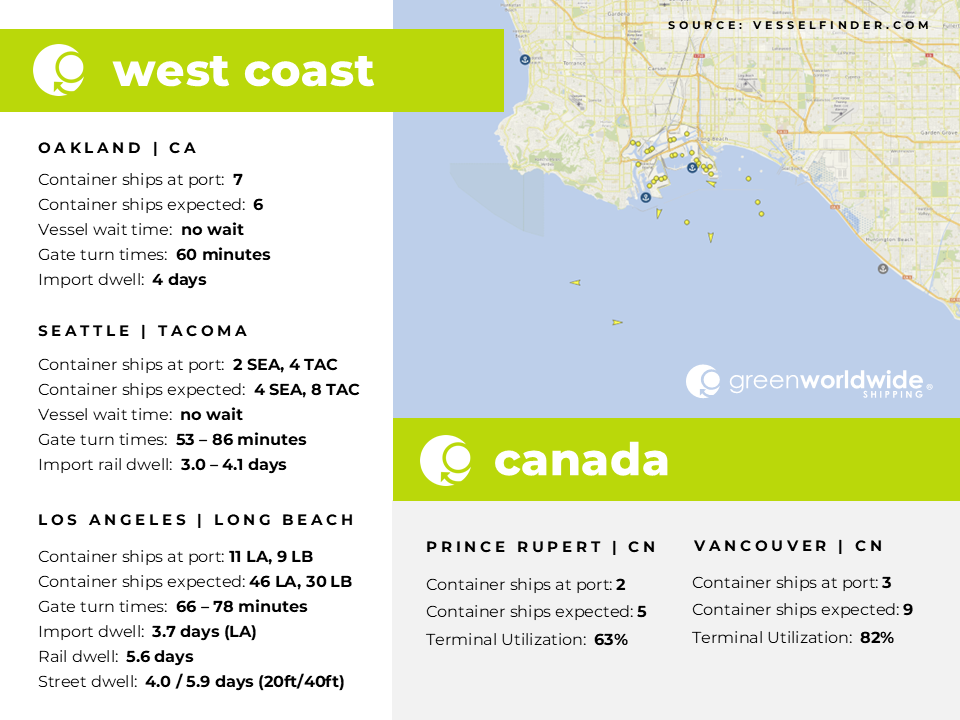
The extension comes as the port complex continues working through elevated cargo volumes. September rail-destined container dwell averaged 7.19 days across Los Angeles and Long Beach, up from 6.75 days in August, according to the Pacific Merchant Shipping Association.
Late October port data also showed elevated inventories of rail-bound import containers awaiting inland movement.
Importers moving cargo through Southern California should continue monitoring terminal and rail conditions and maintain flexibility in pickup, delivery and inland transportation planning while negotiations continue.
GLOBAL CONTAINER VOLUMES REMAIN STRONG DESPITE SOFTER SPOT RATES
Global container trade remained strong in September even as ocean spot rates began to soften.
Container Trade Statistics reported approximately 17.35 million TEUs of global volume during the month, up 8% from September 2025 and down 1.4% from August's record level.
Global container volumes were approximately 5% higher year-over-year through the first nine months of 2026.
North American imports increased 9% year-over-year in September, supported primarily by cargo moving from Asia and Europe.
The data reflects a market where cargo volumes remain elevated even as additional vessel capacity and easing demand place pressure on spot pricing.
AIR CARGO RATES CONTINUE HIGHER DURING Q4 PEAK
Global air cargo spot rates continued to increase as the fourth quarter peak season progressed.
WorldACD reported average spot rates up 4% from the previous week and 40% from the same period last year.
Global chargeable weight was broadly unchanged week-over-week but remained 2% higher than the same week in 2025.
For October overall, worldwide air cargo tonnage increased 6% year-over-year.
Demand from several Asia Pacific origins remains strong as holiday shipping continues.
Shippers moving time sensitive cargo should continue planning bookings early and allow flexibility for changing capacity and pricing conditions through the remainder of peak season.
USTR EXTENDS CHINA SECTION 301 ACTIONS THROUGH JANUARY 9
The Office of the U.S. Trade Representative has extended two China-related Section 301 actions that had been scheduled to expire November 9.
All 178 current China Section 301 product exclusions will remain available through 11:59 p.m. Eastern Time on January 9, 2027.
USTR separately extended the suspension of its Section 301 action involving China's maritime, logistics and shipbuilding sectors through the same deadline.
For importers using one of the current product exclusions, qualifying goods entered for consumption or withdrawn from warehouse for consumption beginning November 10 may continue receiving the applicable exclusion through January 9.
Both extensions remain temporary.
Importers should continue confirming eligibility for applicable exclusions and monitor USTR announcements as the new deadline approaches.
STRAIT OF HORMUZ SECURITY RISKS REMAIN ELEVATED
Security conditions in and around the Strait of Hormuz remain volatile following additional attacks on commercial vessels in November.
The International Maritime Organization reported 131 confirmed incidents in the region as of November 9, with 25 confirmed seafarer fatalities since the current conflict began.
IMO records show additional vessels were damaged in incidents on November 4, November 5 and November 7.
The continued attacks underscore ongoing risks for vessels, crews and cargo moving through one of the world's most important shipping corridors.
Shippers with cargo moving through the Arabian Gulf should continue monitoring vessel routings, schedules and potential disruption as security conditions evolve.
Stay up-to-date on freight news with Green’s Weekly Freight Market Update by following us on LinkedIn. For continuous updates, make sure to check out our website at greenworldwide.com.