
DOWNLOAD THE GUIDE: CBP FORCED LABOR ENFORCEMENT OPERATIONAL GUIDANCE FOR IMPORTERS
U.S. Customs and Border Protection has published a new resource that brings its forced labor enforcement authorities together in one place. The agency announced the CBP Forced Labor Enforcement Operational Guidance for Importers through Cargo Systems Messaging Service (CSMS) message number 68927213. The document carries CBP Publication No. 5560-0526 and was issued by the Office of Trade. For trade and supply chain leaders, it offers a single reference point for how detentions, exclusions, and seizures tied to forced labor actually unfold.
The guidance also changes in scope. It replaces the June 13, 2022 UFLPA Operational Guidance for Importers. In addition, it now covers every forced labor authority CBP enforces, not the Uyghur Forced Labor Prevention Act alone.
THREE FORCED LABOR AUTHORITIES COVERED IN THE NEW GUIDANCE
A central feature of the update is that it pulls three enforcement authorities into one document. Each authority carries its own legal basis, and each one follows its own process.
19 U.S.C. § 1307: WITHHOLD RELEASE ORDERS AND FINDINGS
Under 19 U.S.C. § 1307, CBP investigates allegations of forced labor in global supply chains. First, when the agency has reasonable suspicion that goods were made with forced labor, it issues a Withhold Release Order, or WRO. A WRO directs ports to detain the affected shipments.
By contrast, when CBP has probable cause, and the Secretary of Homeland Security approves, it issues a Finding. A Finding then lets CBP seize the goods and begin forfeiture proceedings. CBP also publishes Findings in the Federal Register and the Customs Bulletin. In addition, it posts both WROs and Findings to its public WROs and Findings Dashboard.
THE UYGHUR FORCED LABOR PREVENTION ACT (UFLPA) 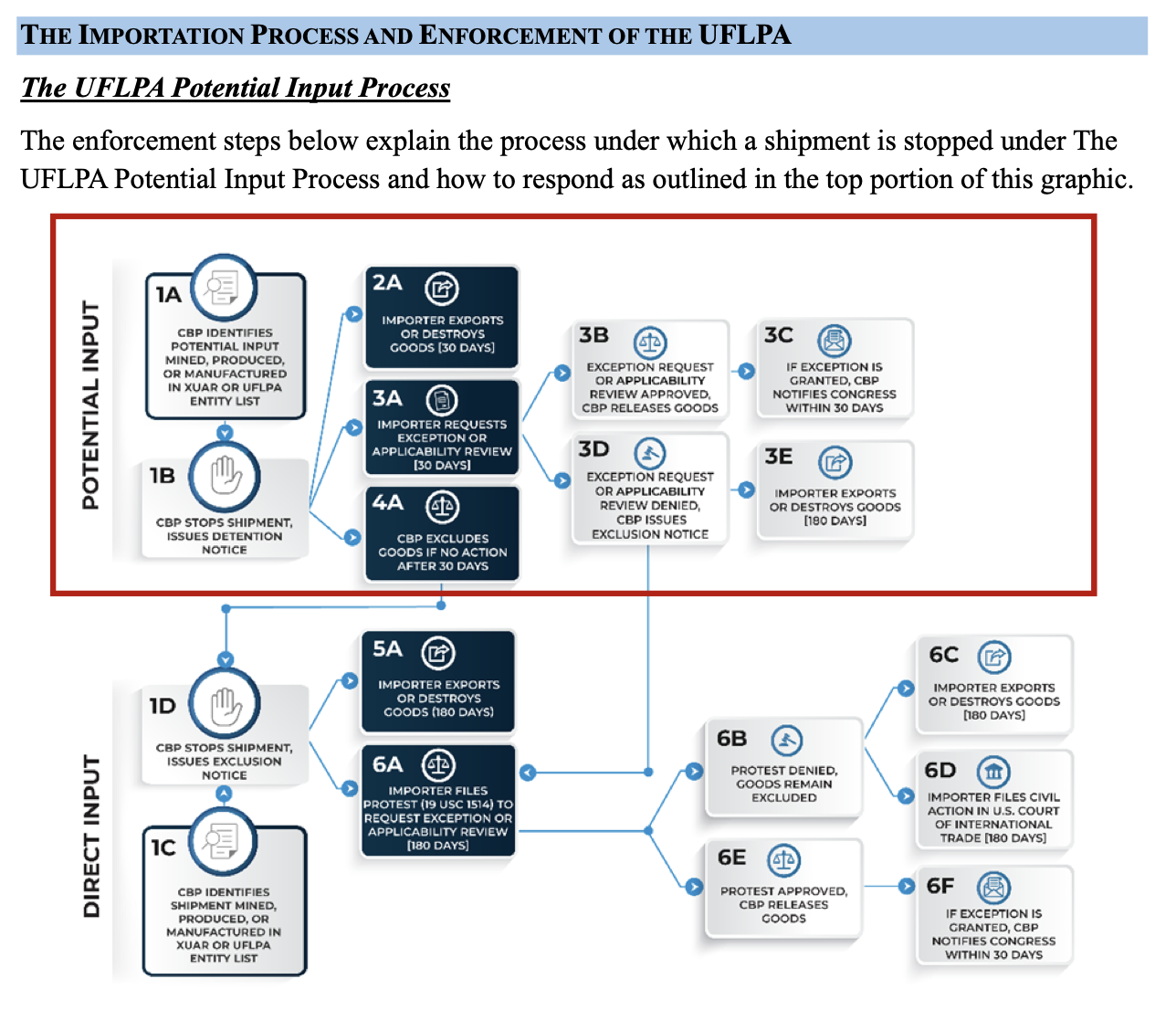
The UFLPA (Public Law 117-78) created a rebuttable presumption. Under it, certain goods are treated as made with forced labor and prohibited under 19 U.S.C. § 1307. Specifically, this covers goods produced wholly or in part in the Xinjiang Uyghur Autonomous Region, or by entities on the UFLPA Entity List.
The Forced Labor Enforcement Task Force maintains that list, and CBP publishes it in the Federal Register. To overcome the presumption, an importer must meet a clear and convincing evidence standard. The importer must also follow the UFLPA Strategy in full.
THE COUNTERING AMERICA’S ADVERSARIES THROUGH SANCTIONS ACT (CAATSA)
CAATSA (22 U.S.C. § 9241a) also sets a rebuttable presumption. It applies to goods produced wholly or in part by North Korean nationals or citizens, anywhere in the world. As a result, such goods are presumed made with forced labor and prohibited under 19 U.S.C. § 1307. The guidance adds that, effective 2024, CBP excludes shipments when it enforces the CAATSA presumption.
NEW FORCED LABOR ENFORCEMENT PROCESS MAPS 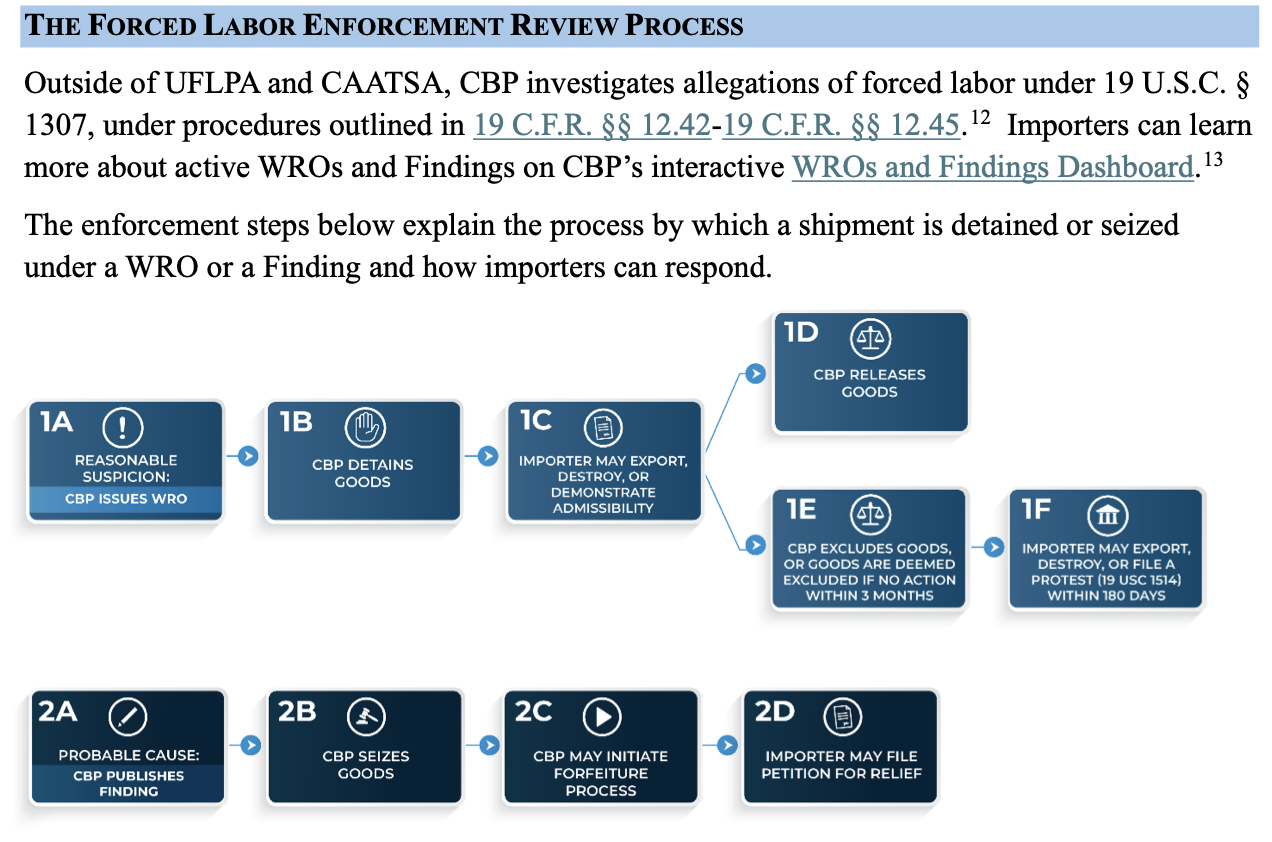
One of the most practical additions is a set of process maps. The guidance now charts each enforcement path step-by-step, so readers can follow what triggers an action and what options follow. In total, the document maps five distinct processes: UFLPA potential input, UFLPA direct input, CAATSA, WRO, and Finding.
UFLPA POTENTIAL INPUT AND DIRECT INPUT
The guidance splits UFLPA enforcement into two tracks. A potential input arises when information suggests goods may come from the XUAR or a listed entity. In that case, CBP may detain the shipment, issue a detention notice, and give the importer 30 days to respond. A direct input arises when information indicates the goods are in fact from the XUAR or a listed entity. There, CBP excludes the shipment, issues an exclusion notice, and allows 180 days to act. The document also describes a detention bond. According to the guidance, CBP may require a basic single-transaction importation customs bond for three times the value of detained goods when it suspects forced labor.
WRO AND FINDING ENFORCEMENT 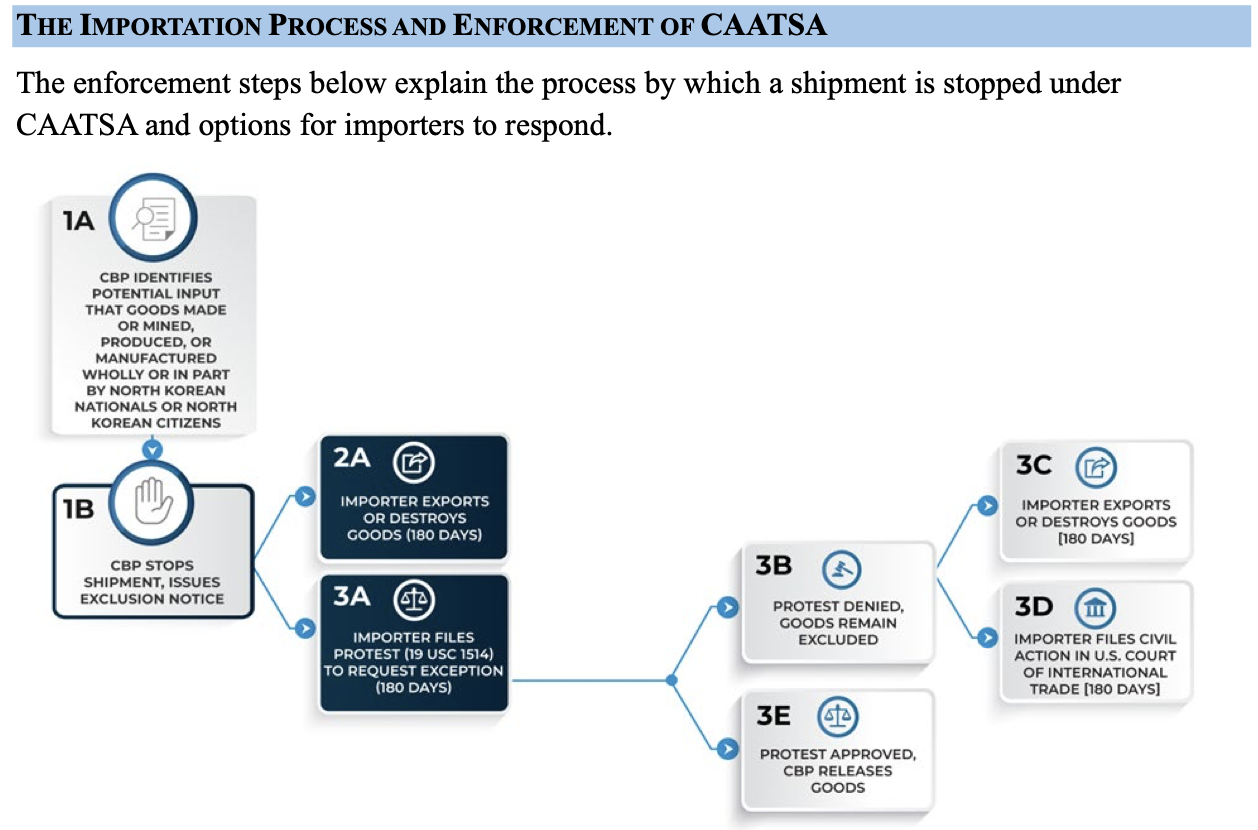
For a WRO, CBP detains the goods and issues a Notice of Detention. The importer then has three months to show the goods are admissible or to export or destroy them. For a Finding, the path differs sharply. CBP may seize the goods, and the guidance states that importers cannot export merchandise subject to a Finding. From there, seized goods move to the Fines, Penalties, and Forfeitures officer at the port, who handles the seizure and any petition for relief.
CAATSA ENFORCEMENT
When CBP identifies a shipment tied to North Korean labor, it stops the shipment and issues an exclusion notice. After that, the importer has 180 days to export or destroy the goods, or to file a protest requesting an exception review.
DETENTION, EXCLUSION, AND SEIZURE TIMEFRAMES AT A GLANCE
The guidance includes a summary that compares the five processes side by side. The table below reflects the key timeframes and outcomes described in the document.
ENFORCEMENT PROCESS |
AUTHORITY |
ACTION ON GOODS |
TIME TO RESPOND |
EXTENSIONS |
| UFLPA potential input | P.L. 117-78 | Detained or excluded | 30 days | Yes, up to two, 90 days total |
| UFLPA direct input | P.L. 117-78 | Excluded | 180 days | No |
| CAATSA | 22 U.S.C. § 9241a | Excluded | 180 days | No |
| WRO | 19 U.S.C. § 1307 | Detained | 3 months | No |
| Finding | 19 U.S.C. § 1307 | Seized | 30 days | No |
One contrast stands out. WRO detentions give importers three months to respond, while UFLPA and CAATSA detentions allow 30 days, with extensions available only before the 30-day window closes.
HOW CBP OFFICES SHARE FORCED LABOR ENFORCEMENT DUTIES
The document also explains which CBP offices handle each part of the process. First, the Forced Labor Division investigates allegations, manages WROs and Findings, and conducts UFLPA and CAATSA exception reviews. Next, the Ports of Entry issue detention, exclusion, and seizure notices and communicate with importers. Meanwhile, the Centers of Excellence and Expertise act as the primary contact for detention inquiries. They also conduct applicability and admissibility reviews by industry sector. Finally, importers submit review requests through CBP’s Forced Labor Portal.
CTPAT TRADE COMPLIANCE BENEFITS FOR FORCED LABOR REVIEWS
The guidance outlines specific benefits for members of the CTPAT Trade Compliance program. According to the document, these members receive:
- Front of the line admissibility review when CBP detains a shipment for forced labor.
- The option to hold redelivered goods intact at their own facility until CBP makes an admissibility determination.
- Preliminary hold notification, which gives advance notice of a possible hold, detention, exclusion, or seizure.
- A 48-hour advance notice whenever CBP issues a new WRO or Finding.
SUPPORTING DOCUMENTATION FOR HIGH-PRIORITY SECTORS
Several appendices give examples of the records CBP may request.
For example, Appendix A lists supply chain tracing documentation for the UFLPA high-priority sectors. Those sectors include aluminum, apparel, caustic soda, copper, cotton, lithium, polyvinyl chloride, red dates, seafood, silica-based products such as polysilicon, steel, and tomatoes.
Other appendices then cover due diligence systems and isotopic testing for origin verification. They also include sample notices for UFLPA, WRO, and CAATSA actions, plus a Notice of Redelivery and a Certificate of Origin.
In addition, the guidance walks through a hypothetical due diligence scenario. It also points to outside resources, such as the U.S. Department of Labor’s List of Goods Produced by Child Labor or Forced Labor.
Separately, the due diligence appendix notes that importers may seek advice from a customs expert. That can include a licensed customs broker, a customs or international trade attorney, or a trade compliance consultant.
PRIOR DISCLOSURE AND REDELIVERY PROVISIONS
The document addresses what happens when an importer finds forced labor goods after import. Under the prior disclosure provision in 19 U.S.C. § 1592, a party that notifies CBP of a violation before the agency discovers it may receive reduced penalties. Separately, CBP can demand redelivery of released goods using Form 4647. The guidance states that a failure to redeliver can lead to liquidated damages of three times the entered value of the merchandise.
FREQUENTLY ASKED QUESTIONS
WHAT IS THE CBP FORCED LABOR ENFORCEMENT OPERATIONAL GUIDANCE FOR IMPORTERS?
It is a consolidated CBP reference, published as CBP Publication No. 5560-0526, that explains the three authorities CBP uses to block goods made with forced labor: 19 U.S.C. § 1307 (WROs and Findings), the UFLPA, and CAATSA. It replaces the 2022 UFLPA-only guidance.
WHICH FORCED LABOR AUTHORITIES DOES THE GUIDANCE COVER?
Three. Section 307 of the Tariff Act of 1930 (19 U.S.C. § 1307), the Uyghur Forced Labor Prevention Act, and the Countering America’s Adversaries Through Sanctions Act.
WHAT IS THE DIFFERENCE BETWEEN A WRO AND A FINDING?
CBP issues a WRO on reasonable suspicion and detains the goods. It issues a Finding on probable cause, with the Secretary of Homeland Security’s approval, and can then seize the goods and begin forfeiture.
HOW LONG DO IMPORTERS HAVE TO RESPOND TO A UFLPA DETENTION?
The guidance states 30 days. In addition, CBP may grant up to two extensions that total 90 calendar days, at its discretion.
WHAT IS THE UFLPA REBUTTABLE PRESUMPTION?
It is the legal principle that certain goods are presumed made with forced labor and barred from entry. This covers goods from the Xinjiang Uyghur Autonomous Region, or from entities on the UFLPA Entity List. The importer can rebut the presumption only with clear and convincing evidence.
WHERE DO IMPORTERS SUBMIT FORCED LABOR REVIEW REQUESTS?
Through CBP’s Forced Labor Portal at flportal.cbp.gov.
WHERE CAN THE FULL GUIDANCE BE FOUND?
On the CBP guidance page, with questions directed to [email protected].
Stay up-to-date on freight news with Green’s Weekly Freight Market Update by following us on LinkedIn. For continuous updates, make sure to check out our website at greenworldwide.com.