

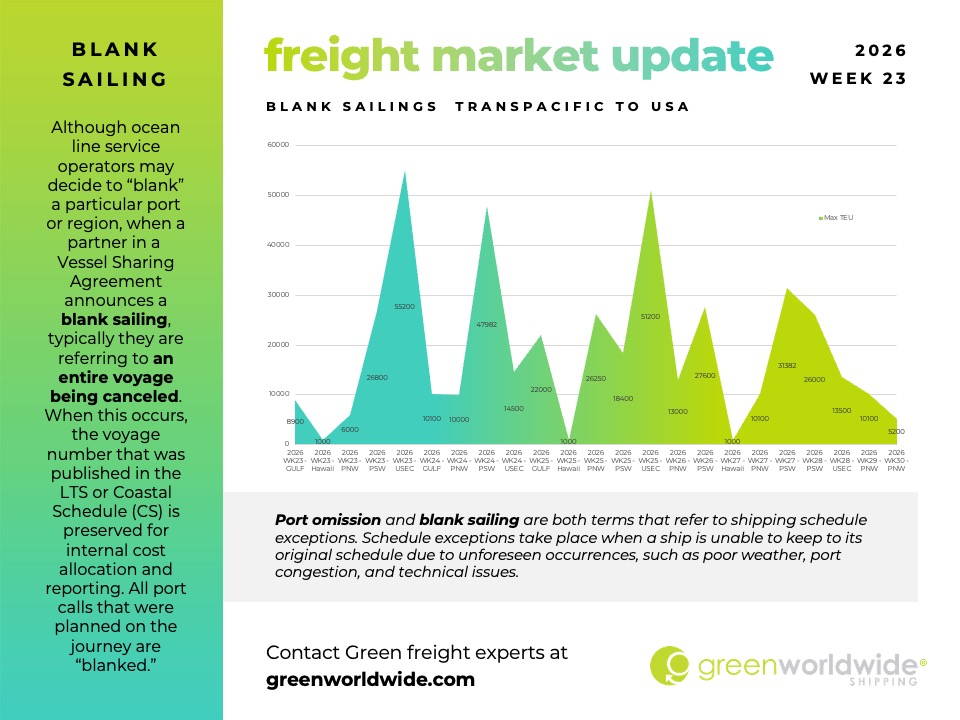
Trans-Pacific space remained tight entering June as strong booking demand continued across Asia-U.S. trade lanes. Carriers have added select extra loader sailings to support U.S. West Coast movement, but capacity relief remains uneven. U.S. East Coast and Gulf Coast services remain the most constrained, with several sailings from China and Vietnam already fully booked through late June.
TRANS-PACIFIC DEMAND KEEPS SPACE CONDITIONS TIGHT
Containerized export demand from Asia remains elevated for June, keeping pressure on vessel allocation across the Trans-Pacific. Booking activity continues to favor earlier planning windows, especially for cargo moving from China, Vietnam, and Southeast Asia origins into U.S. East Coast and Gulf Coast gateways.
While additional loader vessels are scheduled for select U.S. West Coast services, available space remains limited and origin teams continue to manage bookings case by case. Shippers moving time-sensitive cargo should review booking windows by origin, destination coast, equipment type, and cargo weight before confirming production or delivery timelines.
U.S. EAST COAST AND GULF SERVICES REMAIN THE MOST CONSTRAINED
U.S. East Coast and Gulf Coast capacity remains especially tight from China and Vietnam, with many sailings already fully booked through the end of June. Heavy cargo is also facing added scrutiny on select services, including weight restrictions on certain Vietnam and China direct services to Gulf ports.
Maersk has also announced new heavy-load controls for Far East Asia to East Coast North America cargo effective July 1, 2026, based on gross container weight thresholds for 20-foot and 40-foot equipment. This reinforces the need for accurate VGM planning and early routing review for dense or heavy shipments.
EXTRA LOADERS ADD LIMITED WEST COAST RELIEF
Carriers have deployed several supplemental sailings in June, primarily supporting Pacific Southwest demand. Scheduled extra loader activity includes China, Thailand, Vietnam, Malaysia, and transshipment-linked origins connecting to Los Angeles, Oakland, Houston, Mobile, Savannah, New York, and Norfolk.
However, this added capacity does not create uniform market relief. U.S. West Coast space may improve selectively where extra loaders are available, while U.S. East Coast and Gulf Coast allocations remain tighter due to strong demand, limited vessel openings, and rolling activity on several services.
ASIA EXPORT GATEWAYS SHOW UNEVEN CAPACITY CONDITIONS
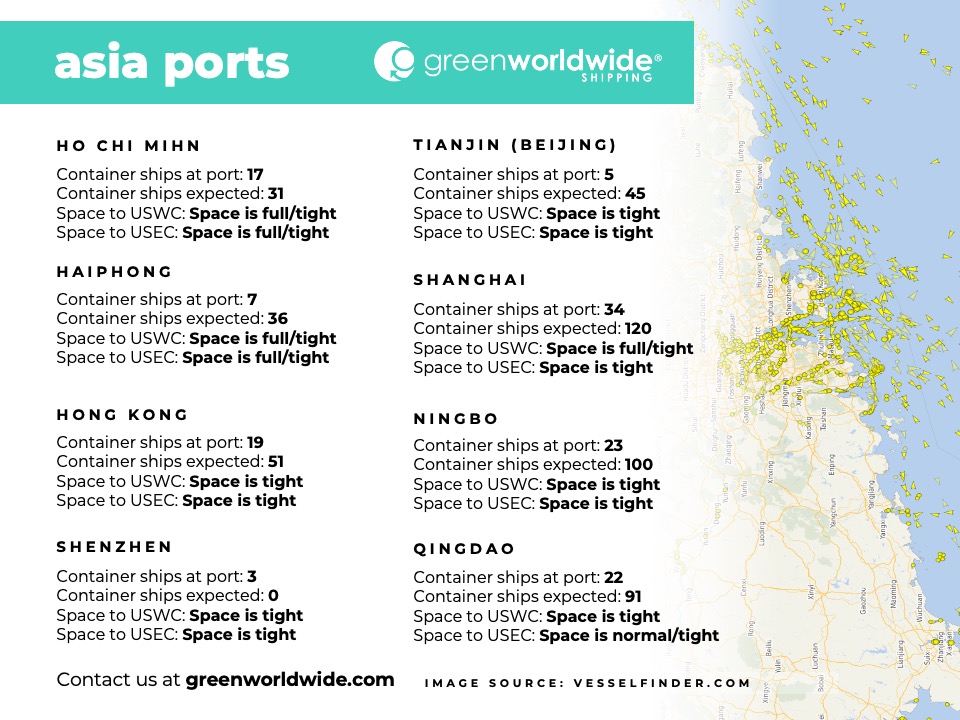
China origin conditions remain mixed by port and destination coast. Shanghai, Ningbo, Yantian, Shenzhen, Taiwan, Nanjing, Wuhan, and Chongqing continue to show tight space across several U.S.-bound lanes. Rolling risk remains active on multiple services, particularly where carrier allocations are already full or constrained.
Some origins, including Fuzhou and Dalian, are showing more balanced space conditions overall, although transshipment exposure may still affect schedule reliability. Xiamen is generally more balanced to U.S. West Coast and Pacific Northwest destinations, while East Coast and Gulf options remain tighter.
SOUTHEAST ASIA BOOKING WINDOWS REMAIN EXTENDED
Vietnam remains one of the most constrained Southeast Asia origins for U.S.-bound cargo. Several carriers show full or tight conditions for early June sailings from Ho Chi Minh City and Haiphong, with more normalized space expected later in the planning window.
Indonesia also remains tight, with bookings requiring three to four weeks of advance planning. Cambodia continues to face feeder delays from Phnom Penh and tight or full space on several carrier services through Weeks 24 and 25. Thailand, the Philippines, and Singapore show more mixed conditions, with near-term tightness on select carriers and more normalized capacity later in the month.
EQUIPMENT AVAILABILITY REMAINS ORIGIN AND SIZE SPECIFIC
Equipment availability remains manageable in several Asia origins, but not uniform. Select 40-foot and 40-foot high cube equipment remains tight in Shanghai, Ningbo, Wuhan, Chongqing, Shenzhen, Taiwan, and Vietnam, depending on carrier and origin. Special equipment continues to require case-by-case confirmation across most China and Southeast Asia origins.
In the Philippines, most equipment remains available, although 40-foot equipment for food-grade cargo is tight in Cebu and Davao. Indonesia continues to show tightness for 40-foot equipment, while Thailand, Cambodia, and Singapore remain broadly normal for standard equipment, with special equipment subject to review.
AIRFREIGHT CAPACITY IMPROVES ON CHINA-U.S. LANES
China-U.S. airfreight capacity has improved as stocking demand eased. Cargo volume declined week-over-week and year-over-year, creating more available capacity for shippers with urgent cargo needs.
The broader Asia air market remains uneven. Hong Kong is seeing increased space demand on Trans-Pacific lanes, while Southeast Asia activity has strengthened, led by garments, electronics, and metalware. Capacity planning remains important for cargo with narrow delivery windows, especially where ocean bookings are constrained or subject to rolling.
Stay up-to-date on freight news with Green’s Weekly Freight Market Update by following us on LinkedIn. For continuous updates, make sure to check out our website at greenworldwide.com.