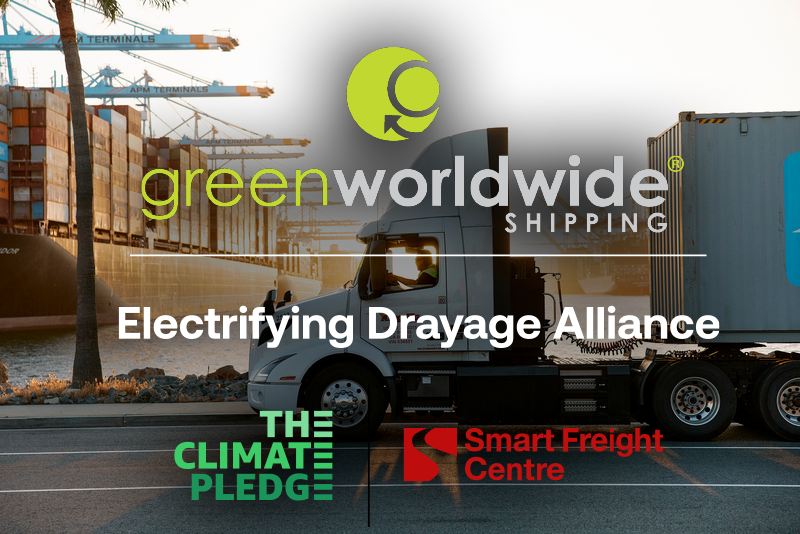
Green Worldwide Shipping has joined the Electrifying Drayage Alliance (EDA), a global coalition that brings the freight value chain together to advance electric drayage at major ports. The alliance is a partnership between The Climate Pledge and Smart Freight Centre. Through this voluntary, non-binding collaboration, Green will work alongside shippers, ports, carriers, and infrastructure partners to help address the practical barriers that slow heavy-duty truck electrification.
For a freight forwarder already active in maritime and road freight decarbonization, the move is a natural next step. Drayage sits at the front door of the supply chain, and it is one of the most workable places to put electric trucks on the road today.
WHAT IS THE ELECTRIFYING DRAYAGE ALLIANCE?
The Electrifying Drayage Alliance is a global collaboration platform built through a partnership between The Climate Pledge and Smart Freight Centre. It connects shippers and cargo owners, logistics service providers, drayage operators, ports, terminals, charging infrastructure providers, vehicle manufacturers, and financial partners around one shared goal: making electric drayage work at the world’s busiest ports. Rather than mandating fleet purchases, the alliance helps members connect global ambition with local action. It supports port-level coalitions, practical roadmaps, and pre-competitive learning on the deployment barriers that no single company can solve alone.
The EDA currently focuses on priority ports where participants have operational relevance. In North America, those ports include Los Angeles-Long Beach, Seattle-Tacoma, and New York-New Jersey. Across Europe, the list covers London Gateway, Southampton, Rotterdam, and Antwerp. In Asia, the alliance is active at Chennai, Shanghai, and Shenzhen. Additional ports may join as participation grows.
WHY DRAYAGE IS THE RIGHT PLACE TO START
Drayage refers to the short movement of containers between ports and nearby warehouses or distribution facilities. Those routes are short, repeatable, and predictable, which makes them well suited to battery-electric trucks. Because port ecosystems concentrate cargo flows and infrastructure in one place, they offer a practical entry point for heavy-duty freight electrification. Many ports also face rising air quality and emissions requirements, so the pressure to act is already present.
The catch is that the barriers are shared. Charging availability, grid capacity, vehicle supply, and route planning cannot be solved by one operator working alone. Coordinated action lowers risk, builds confidence, and helps the whole ecosystem move faster. That logic sits behind the alliance, and it is why Green views drayage as a sensible first step rather than a distant goal.
WHAT EDA PARTICIPATION INVOLVES
Joining the EDA is a voluntary participation commitment, not a binding contract. It does not require Green to deploy electric trucks, make a financial contribution, or enter into commercial agreements. Instead, participation means engaging in good faith where the alliance is relevant to Green’s operations and expertise.
In practice, Green will help identify relevant ports, contribute non-confidential insights on deployment barriers, and take part in selected working sessions where useful. The company will continue to make all commercial, procurement, and operational decisions independently. Every interaction follows competition law and the alliance’s information-sharing principles, which keep discussions focused on pre-competitive topics such as infrastructure, stakeholder coordination, and shared learning.
“Drayage is the easiest place in freight to make electrification happen, but impossible to do alone. Charging, grid capacity, truck supply: none of it gets solved by one company,” says Anne Shudy Palmer, Director of Sustainability, Green Worldwide Shipping. “That’s why we joined the EDA, to help build the shared answers that get more zero-emission trucks hauling our customers’ freight sooner.”
HOW THE ALLIANCE WORKS IN PRACTICE
The EDA operates across four connected layers:
- Global platform: raising awareness, building momentum, and recognizing leadership across the freight sector.
- Local coalitions: practical engagement at priority ports where participants have operational relevance.
- Port roadmaps: identifying local barriers, opportunities, and actions that support electric drayage deployment.
- Implementation support: continued learning, stakeholder connection, and hands-on engagement.
Participation can be light or active, depending on a member’s priorities, relevant ports, and internal capacity. There is no minimum meeting requirement and no fixed term, so members engage at a pace that fits their readiness.
HOW THIS FITS GREEN’S SUSTAINABILITY PROGRAM
Membership in the EDA extends a sustainability program that Green has been building for years. The company is already a member of Smart Freight Centre, one of the two organizations behind the alliance, and takes part in several SFC programs. Green also belongs to the Zero Emission Maritime Buyers Alliance (ZEMBA) and the Center for Green Market Activation’s GMA Trucking buyers’ alliance, both of which use book-and-claim models to direct investment toward zero-emission transport.
Those commitments have moved quickly this month. Green just endorsed the Global Memorandum of Understanding on Zero-Emission Medium- and Heavy-Duty Vehicles, joining a worldwide coalition working toward 100% zero-emission new truck and bus sales by 2040. Around the same time, the Science Based Targets initiative formally recognized book-and-claim certificates for corporate net-zero targets, with the ZEMBA and GMA programs named among the recognized instruments. The EDA adds a port-focused dimension to that momentum, connecting Green’s domestic freight footprint to the places where drayage electrification will scale first. For customers, the through line stays consistent: practical, market-based pathways to reduce Scope 3 transportation emissions.
FREQUENTLY ASKED QUESTIONS
Does joining the EDA mean Green is committing to an all-electric fleet?
No. Participation is voluntary and non-binding. It does not require Green to deploy electric trucks or make public deployment commitments. Green continues to make fleet and procurement decisions independently.
Which ports does the alliance focus on?
Current North American priority ports include Los Angeles-Long Beach, Seattle-Tacoma, and New York-New Jersey. The alliance is also active at European and Asian ports such as Rotterdam, Antwerp, Shanghai, and Shenzhen.
Who runs the Electrifying Drayage Alliance?
The alliance is a partnership between The Climate Pledge, a commitment to reach net-zero carbon emissions by 2040, and Smart Freight Centre, a global non-profit focused on cutting freight and logistics emissions.
How does this benefit Green’s customers?
Members gain visibility into developments at priority ports, access to pre-competitive collaboration, and connections across the freight value chain. Over time, that helps Green support customers who are working to lower their transportation emissions.
BUILDING THE COALITION THAT MOVES FREIGHT FORWARD
Electric trucks are already moving cargo at major ports. By joining the Electrifying Drayage Alliance, Green is helping build the coalition that turns early progress into industry-wide momentum. To learn more about how Green approaches responsible logistics, visit Green’s sustainability program.
Stay up-to-date on freight news with Green’s Weekly Freight Market Update by following us on LinkedIn. For continuous updates, make sure to check out our website at greenworldwide.com.