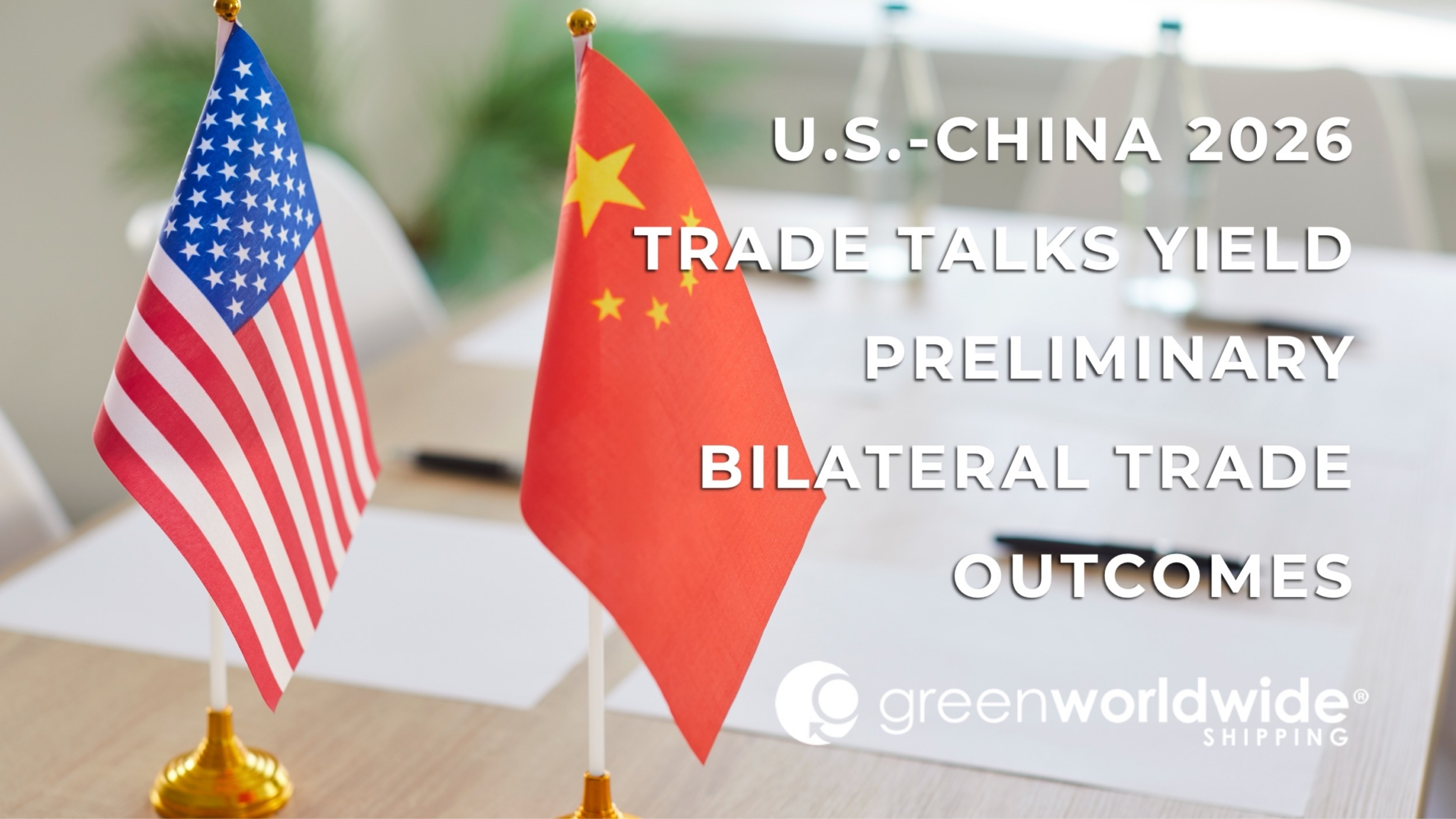
Following economic and trade consultations in Seoul and a heads-of-state meeting in Beijing, China and the United States have released a preliminary set of bilateral trade outcomes. For importers, exporters, and logistics operators on this trade lane, the outcomes touch four areas: tariff arrangements, agricultural trade, rare earth export controls, and the extension of the Kuala Lumpur Joint Arrangement.
READ THE WHITE HOUSE FACT SHEET: PRESIDENT DONALD J. TRUMP SECURES HISTORIC DEALS WITH CHINA, DELIVERING FOR AMERICAN WORKERS, FARMERS, AND INDUSTRY
WHAT DID THE U.S. AND CHINA AGREE TO ON TARIFFS?
China’s official interpretation of the consultations states that any future U.S. tariffs on Chinese goods, regardless of the legal mechanism used, must not exceed the levels established under the October 2025 Kuala Lumpur Joint Arrangement. The U.S. side has not publicly confirmed a tariff ceiling at that level. That arrangement set the reciprocal tariff baseline at 20%, excluding existing Section 232 and Section 301 tariffs. The current rate under Section 122 sits at 10%, though the Section 122 tariff ruling has raised questions about its scope and a Federal Circuit stay is currently in effect pending appeal. Section 232 and Section 301 tariffs apply on top by commodity.
The U.S. Administration has two active Section 301 investigations targeting Chinese goods and has signaled intent to use Section 301 tariffs to replace the IEEPA tariffs ruled unlawful by the Federal Circuit and subsequently struck down by the U.S. Supreme Court earlier this year. The active Section 301 investigations and existing exclusion landscape remain a separate variable. Both sides also agreed in principle to a reciprocal tariff reduction framework covering $30 billion or more in products on each side, with most-favored-nation rates or lower potentially applicable to agreed categories.
WHAT AGRICULTURAL TRADE COMMITMENTS WERE MADE?
The agricultural outcomes were the most specific in the preliminary release. On the U.S. export side, China restored registration of more than 400 U.S. beef facilities and added new listings, lifted HPAI-related poultry import restrictions from qualifying states, and committed to expediting review of beef enterprises suspended for drug residue issues. Both governments confirmed a commitment for China to purchase at least $17 billion per year in U.S. agricultural products in 2026, 2027, and 2028, in addition to soybean purchase commitments made in October 2025.
On the Chinese export side, the U.S. committed to lifting automatic detention measures on Chinese dairy products and dairy-containing foods in place since 2008, accepting a pilot program for Chinese growing-medium bonsai (also referenced as potted plants), and working toward lifting detention measures on three categories of Chinese aquatic products. Both sides agreed in principle to include relevant products in the reciprocal tariff reduction framework and set indicative targets for expanding two-way agricultural trade.
WHAT IS THE STATUS OF RARE EARTH EXPORT CONTROLS?
Both sides held discussions on rare earth minerals export controls and agreed to jointly study and address each other’s concerns within existing legal and regulatory frameworks. China’s export licensing regime for materials including yttrium, scandium, neodymium, and indium remains in place, with compliant civilian license applications subject to review. No blanket removal of controls was announced.
WHEN DOES THE KUALA LUMPUR JOINT ARRANGEMENT EXPIRE AND WHAT HAPPENS NEXT?
The October 2025 Kuala Lumpur arrangement, which suspended 24% reciprocal tariffs, China’s corresponding retaliatory measures, the 50% export control pass-through rule, and Section 301 maritime and shipbuilding measures, runs through November 10, 2026. Both sides reaffirmed their commitment to extending it, with economic and trade teams actively working on the terms.
November 10, 2026, is the current expiration date for the arrangement’s suspended measures.
Stay up-to-date on freight news with Green’s Weekly Freight Market Update by following us on LinkedIn. For continuous updates, make sure to check out our website at greenworldwide.com.