

Global freight conditions remain uneven heading into the final week of September. Trans-Pacific container rates moved higher in the latest weekly assessment as carriers continued adjusting capacity ahead of China's Golden Week, while U.S. import volumes are now forecast to reach their highest level of 2026 in September.
At the same time, commercial vessel traffic through the Strait of Hormuz remains sharply reduced amid continued security concerns, German port labor negotiations remain unresolved, and several U.S. trade and customs measures are moving into active implementation.
MARKET SUMMARY OVERVIEW
Drewry's World Container Index increased 1% in its September 17 assessment.
Shanghai-to-Los Angeles rates increased 5%, while Shanghai-to-New York rose 7%. Asia-Europe rates moved in the opposite direction, with Shanghai-to-Genoa down 5% and Shanghai-to-Rotterdam down 9%.
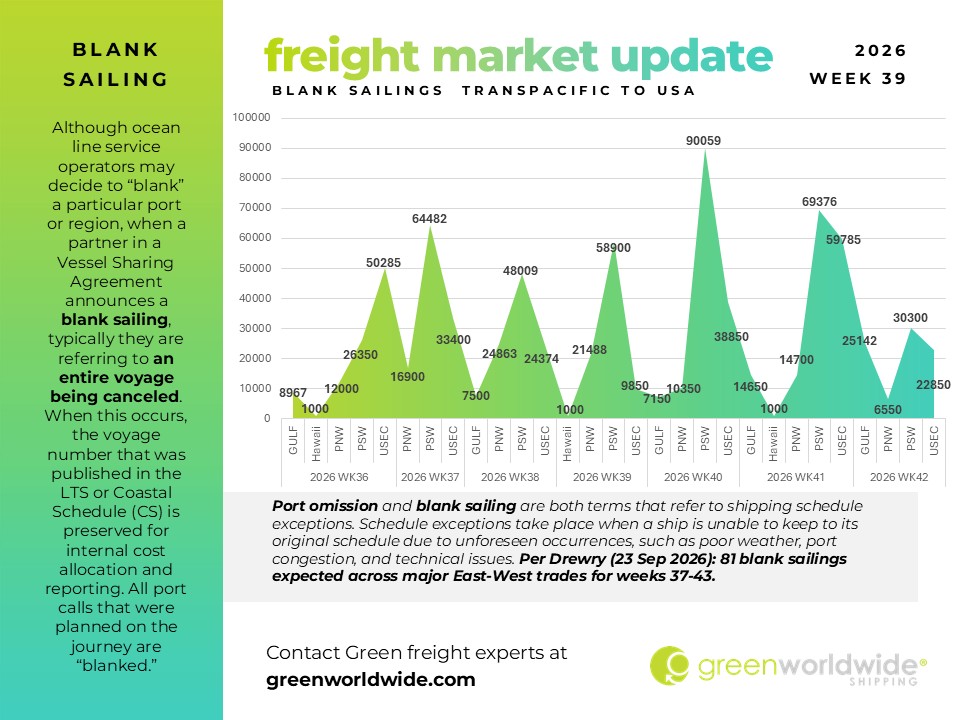
Carriers are also continuing to adjust capacity across the major East-West trades. Drewry expects 77 blank sailings between Weeks 39 and 43 out of 720 planned sailings, representing an 11% cancellation rate. Of those cancellations, 55% are expected on the eastbound Trans-Pacific, 31% on Asia-North Europe/Mediterranean and 14% on the Transatlantic.
For importers, the current market remains highly lane specific. Trans-Pacific pricing is elevated in the latest published benchmark, while Asia-Europe rates continue to soften and capacity adjustments remain an important factor around Golden Week.
TRANS-PACIFIC RATES RISE AS GOLDEN WEEK APPROACHES
Trans-Pacific spot rates moved higher in the latest weekly assessment as pre-holiday demand and capacity management continued to support pricing. For importers, this means available space can vary significantly by service even when overall market capacity remains available.
Importers with cargo moving during late September and early October should continue reviewing:
- Current sailing schedules and cargo cutoffs
- Available space by origin and destination
- Blank sailings and revised rotations
- Potential rollover exposure for time sensitive cargo
- East Coast versus West Coast routing and pricing
U.S. IMPORT PEAK EXTENDS INTO SEPTEMBER
U.S. container imports are remaining stronger later into peak season than earlier forecasts suggested.
The National Retail Federation and Hackett Associates now forecast 2.31 million TEUs in September, up 9.6% year-over-year and slightly above July, which would make September the busiest import month of 2026 if the forecast holds.
The forecast represents a meaningful shift from earlier expectations that peak season importing would largely be complete by this point in the year.
NRF attributed part of the later peak to vessel delays caused by severe weather in China and some rerouting away from the Panama Canal, while consumer demand and retailer inventory needs have also remained supportive.
For importers, sustained overall demand can coexist with tighter space on individual services as carriers simultaneously adjust capacity around Golden Week. Cargo ready dates, available departures and destination requirements should continue to be reviewed shipment by shipment.
STRAIT OF HORMUZ TRAFFIC REMAINS SHARPLY REDUCED
Commercial vessel traffic through the Strait of Hormuz remains significantly below normal levels as security conditions continue to affect shipping through the region.
Preliminary Kpler data reported by Reuters showed only two commodity vessels crossing the Strait on September 21, down from 10 the previous day. Before the current conflict, the Strait typically handled approximately 125 large commercial vessels per day, including tankers, gas carriers, bulk vessels and container ships.
Visible vessel counts do not include ships transiting with Automatic Identification System transponders turned off, meaning actual traffic may be higher than tracking data indicate.
Security risk also remains elevated. On September 21, a tanker conducting an inbound transit was struck by an unknown projectile, according to UK Maritime Trade Operations. Two crew members sustained minor injuries, and the vessel continued under its own power.
Current carrier advisories continue to include booking restrictions and routing changes for certain cargo types and Gulf destinations.
For importers and exporters with freight moving through the region, service availability, routings and cargo acceptance should continue to be confirmed before shipment.
GERMAN PORT LABOR BALLOT CONTINUES THROUGH OCTOBER 1
Labor negotiations at Germany's major seaports remain unresolved following the rejection of the latest employer offer.
In a member survey completed in September, 64.7% of participating workers voted to reject the latest offer, which included a 3.4% wage increase retroactive to August 1 and an additional €200 in holiday pay over a 12-month term.
The union is now conducting a formal member ballot through the evening of October 1.
At least 75% of participating members must support rejection of the offer and the initiation of indefinite strikes before the union's national bargaining commission can determine that negotiations have failed and consider further strike action.
No indefinite strike has been announced.
The employer association has warned that prolonged disruption could cause cargo to shift toward competing North European gateways, including Rotterdam and Antwerp-Bruges.
Importers using Hamburg, Bremen, Bremerhaven, Emden, Brake or Wilhelmshaven should continue monitoring the ballot outcome and maintain flexibility around time sensitive cargo.
ASIA-PACIFIC AIR CARGO RATES CONTINUE HIGHER
Asia-Pacific air cargo pricing increased for a third consecutive week in the latest market data.
WorldACD reported that chargeable weight from Asia-Pacific origins increased 4% week-over-week in Week 37, while average spot rates rose another 3%.
The increase followed two earlier weekly gains in spot pricing, although WorldACD noted that part of the volume growth reflected a rebound following holidays in Vietnam and Malaysia.
For shippers using air freight for time sensitive inventory, rising spot pricing reinforces the importance of reviewing available capacity and routing before shipment urgency limits options.
SECTION 338 IMPORT PROHIBITIONS TAKE EFFECT SEPTEMBER 29
New U.S. import prohibitions on certain Canadian-origin products are scheduled to take effect at 12:01 a.m. Eastern Time on September 29.
The measures apply to specified Canadian products in categories including certain alcoholic beverages, dairy products and motor vehicles that are identified in the applicable proclamations and annexes. The measures do not apply broadly to all Canadian goods in those sectors.
For affected products that were imported before September 29 but had not yet been entered for consumption or withdrawn from warehouse for consumption, the existing 50% additional duty treatment remains applicable rather than the import prohibition.
Importers with Canadian-origin goods potentially within the affected classifications should confirm product scope and entry timing before September 29.
CBP IMPORTER OF RECORD ENFORCEMENT IS NOW ACTIVE
U.S. Customs and Border Protection's enhanced Importer of Record verification measures took effect September 18.
CBP may void an Importer of Record number when information provided on Form 5106 is inaccurate or incomplete. Required information, including physical addresses, email addresses, phone numbers and applicable identification information, must be accurate, complete and belong directly to the Importer of Record.
A voided IOR number becomes invalid for purposes including entering imported merchandise into the United States.
Importers should ensure that current Form 5106 records remain accurate and up to date.
Stay up-to-date on freight news with Green’s Weekly Freight Market Update by following us on LinkedIn. For continuous updates, make sure to check out our website at greenworldwide.com.