

Global freight markets enter September with elevated ocean rates, continued capacity adjustments and new operational pressure across several key trade lanes.
Severe weather is creating additional disruption at major Chinese gateways, while Trans-Pacific demand remains firm heading toward Golden Week. In Europe, German port labor negotiations remain unresolved following the rejection of the latest employer offer, and Panama Canal transit restrictions are now beginning to take effect.
Meanwhile, carriers continue selectively restoring Suez Canal routings, and air cargo volumes from China and Hong Kong to Europe are showing early signs of stabilization following several weeks of decline.
MARKET SUMMARY OVERVIEW
Drewry’s World Container Index (WCI) decreased 1% for the week ending August 27. Trans-Pacific rates also declined 1%, while Asia–North Europe/Mediterranean rates fell 2%. Despite the weekly decrease, the WCI remains 111% above the same period last year.
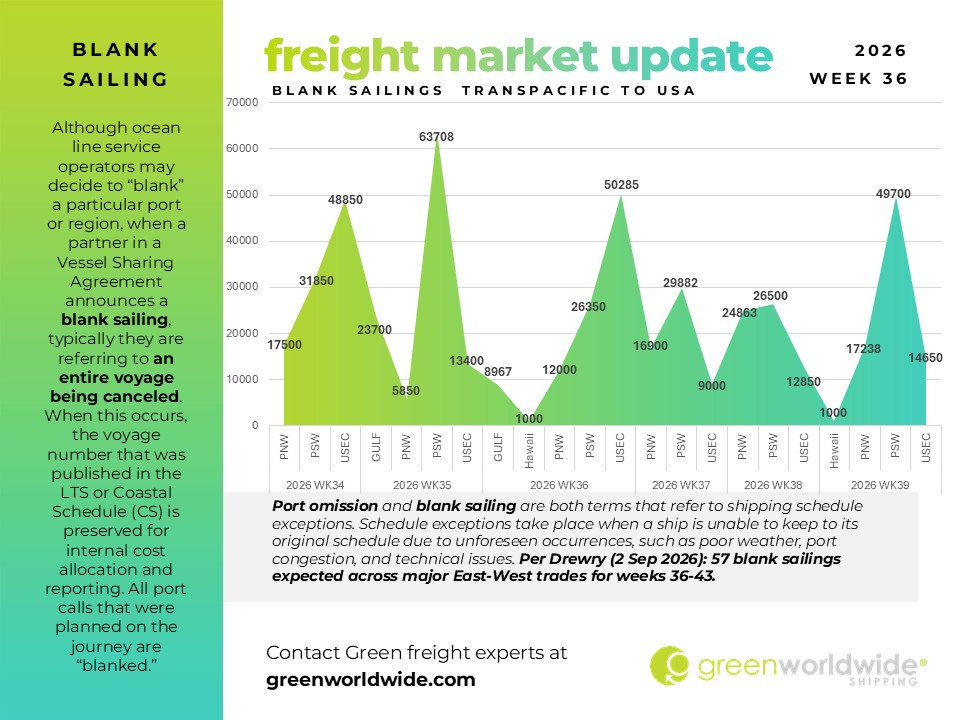
Capacity management also remains a factor heading into September. Drewry expects 45 blank sailings across major East-West trades between Weeks 36 and 40, representing approximately 6% of scheduled sailings. Of the announced cancellations, 54% are concentrated on the Trans-Pacific eastbound trade, followed by Asia–North Europe/Mediterranean at 28% and the Transatlantic at 18%.
Weather disruption across Asia, Panama Canal constraints and continued adjustments to global vessel routings are adding complexity to network planning even as overall capacity remains available.
CHINA PORT DISRUPTIONS CONTINUE FOLLOWING LATEST TYPHOON
Severe weather continues to disrupt cargo movement across key Chinese ports following Typhoon Saudel, adding to several weeks of weather related schedule disruption across North and East Asia.
Although major terminals have resumed operations following temporary closures, the effects are continuing across carrier networks. Industry reports point to growing instances of rolled cargo, transshipment and skipped vessel calls, while increasing yard density is creating additional pressure at regional gateways.
Hapag-Lloyd has reported vessel waits at Ningbo of up to five days for Gemini services and three to six days for non-Gemini loops as carriers work delayed vessels and containers back into schedule.
Importers with cargo moving through China should continue monitoring upcoming departures and allow additional flexibility around sailing schedules and cargo availability as carriers work through the backlog.
TRANS-PACIFIC MARKET REMAINS FIRM HEADING INTO SEPTEMBER
Trans-Pacific rates eased slightly during the latest reporting period but remain elevated as the market moves into September.
The market is also approaching China’s Golden Week holiday period, with carriers beginning to adjust October sailing schedules around planned factory closures and reduced operating activity.
For importers moving cargo from Asia, September remains an important planning window. Cargo readiness dates, supplier schedules and required delivery timelines should be reviewed early, particularly for time sensitive shipments expected to move immediately before or after the holiday.
INTRA-ASIA RATES RISE AMID CONTINUED WEATHER DISRUPTION
Regional Asian container rates are moving higher as repeated weather disruptions affect vessel schedules and cargo flows.
Drewry’s Intra-Asia Container Index increased 10% during the latest reporting week. Industry reporting indicates rates have been trending higher since early August as storms disrupted carrier services at key Chinese ports.
The disruption can extend beyond individual port closures as delayed vessels, containers and equipment move through interconnected regional networks.
Importers relying on multi-port or regional Asia routings should allow additional flexibility around connections and monitor cargo movement closely as carriers continue working to restore schedules.
PANAMA CANAL TRANSIT RESTRICTIONS BEGIN
The Panama Canal has begun implementing temporary reductions to daily transit availability in response to below expected precipitation across the Canal watershed.
Beginning September 3, daily availability at the Neopanamax Locks was reduced to nine slots, while Panamax availability was set at 25 slots per day. Panamax availability is scheduled to decline further to 23 daily slots beginning September 15.
The Canal is also adjusting its daily auction process, including changes affecting the allocation of available transit slots across vessel categories.
Importers using Panama Canal routings should continue monitoring vessel schedules and booking status, particularly for cargo moving between Asia and the U.S. East and Gulf Coasts.
GERMAN PORT LABOR DISPUTE REMAINS UNRESOLVED
Labor uncertainty continues at Germany’s major seaports after verdi members rejected the latest employer proposal.
The Central Association of German Seaport Companies (ZDS) confirmed September 1 that the union rejected an improved offer that included a 5.1% wage increase over an 18-month term, along with additional compensation measures. ZDS also referenced the possibility of renewed strike action as negotiations remain unresolved.
The agreement covers approximately 11,000 employees at tariff bound port operations including Hamburg, Bremen/Bremerhaven, Wilhelmshaven, Emden and Brake.
Importers with cargo moving through German ports should continue monitoring labor developments and allow flexibility in transportation plans should additional work stoppages occur.
SUEZ ROUTINGS CONTINUE TO EXPAND SELECTIVELY
Ocean carriers continue gradually restoring selected services through the Suez Canal as routing conditions evolve.
MSC announced the partial restoration of Suez transits across a limited number of East-West services, including Asia–Mediterranean, Asia–North Europe and India–Mediterranean routes. The carrier began implementing the changes in late August on a service-by-service basis.
The development adds to the gradual return of carrier services to traditional Suez routings following extended diversions around the Cape of Good Hope.
However, the shift should not yet be viewed as full network normalization. MSC continues to maintain contingency arrangements that allow individual voyages to be adjusted if conditions change.
Importers should continue confirming routing and transit expectations for individual bookings rather than assuming a broader return to Suez across all services.
AIR CARGO: CHINA-EUROPE VOLUMES SHOW EARLY SIGNS OF STABILIZATION
Air cargo volumes from China and Hong Kong to Europe are showing early signs of stabilization following several weeks of decline.
WorldACD reported that combined tonnage from mainland China and Hong Kong to Europe increased 1% week over week during Week 34, marking the first weekly increase since early June.
Volumes remain well below year ago levels, however. Mainland China–Europe tonnage was down 8% year over year, while Hong Kong–Europe volumes remained 33% lower. WorldACD has linked much of the earlier decline to changes in European Union import rules that took effect July 1 and particularly affected low value e-commerce traffic.
The latest data may indicate that the market is beginning to stabilize at a lower level, but importers should continue monitoring demand and capacity before assuming a broader recovery.
Stay up-to-date on freight news with Green’s Weekly Freight Market Update by following us on LinkedIn. For continuous updates, make sure to check out our website at greenworldwide.com.