

Global freight markets enter the second half of September with increasingly different conditions across major trade lanes. Trans-Pacific rates moved higher while Asia–Europe pricing declined, and carriers sharply increased blank sailing activity ahead of China's Golden Week holiday.
At the same time, congestion remains elevated at several major Chinese ports, Panama Canal transit capacity tightened further this week, German port labor negotiations remain unresolved, and additional Asia–Europe services are returning to the Suez Canal.
MARKET SUMMARY OVERVIEW
Drewry's World Container Index remained stable for the week ending September 10, marking its second consecutive week with little overall movement.
Conditions varied considerably by trade lane. Shanghai–Los Angeles rates increased 2%, while Shanghai–New York rose 1%. Shanghai–Genoa declined 3%, and Shanghai–Rotterdam fell 2%.
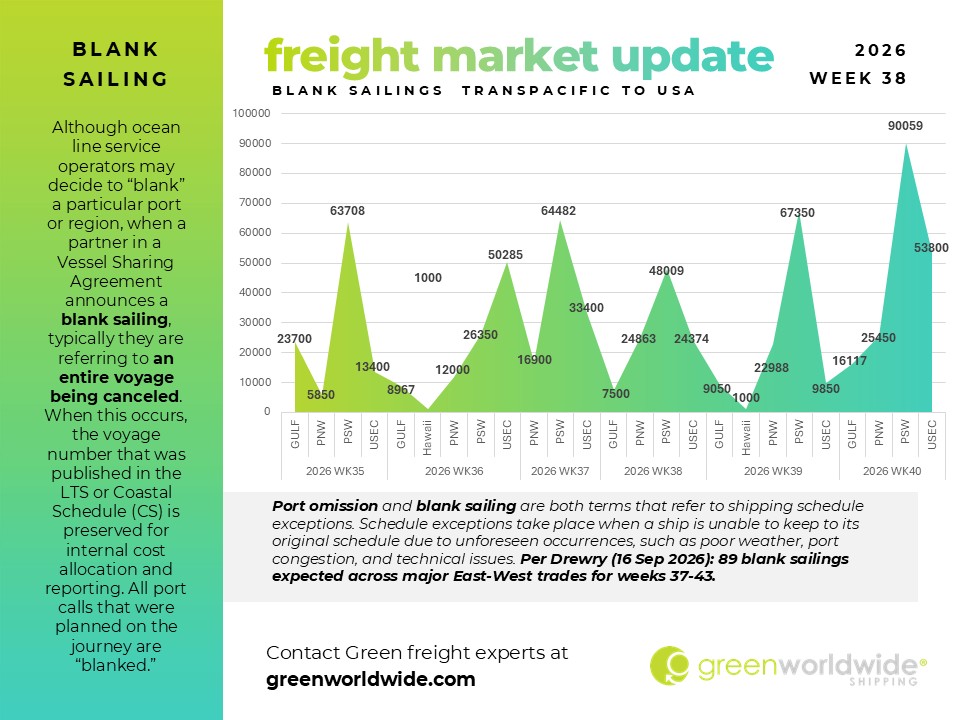
Capacity management also accelerated ahead of Golden Week. Drewry currently expects 79 blank sailings across 721 scheduled sailings between Weeks 38 and 42, representing approximately 11% of planned sailings across the major East–West trades.
BLANK SAILINGS INCREASE AHEAD OF GOLDEN WEEK
Carrier capacity adjustments increased significantly during the past week as China's Golden Week holiday approaches.
Announced blank sailings for Weeks 38 through 41 increased nearly 56% in one week, from 39 to 70 cancellations. Across the broader Weeks 38–42 period, 79 blank sailings are currently expected.
Trans-Pacific eastbound services account for approximately 52% of announced cancellations, followed by Asia–North Europe/Mediterranean at 33% and Trans-Atlantic services at 15%.
Importers with upcoming Asia-origin cargo should continue reviewing supplier readiness, booking availability and alternative departures as carriers adjust capacity around the holiday period.
CHINA PORT CONGESTION REMAINS ELEVATED
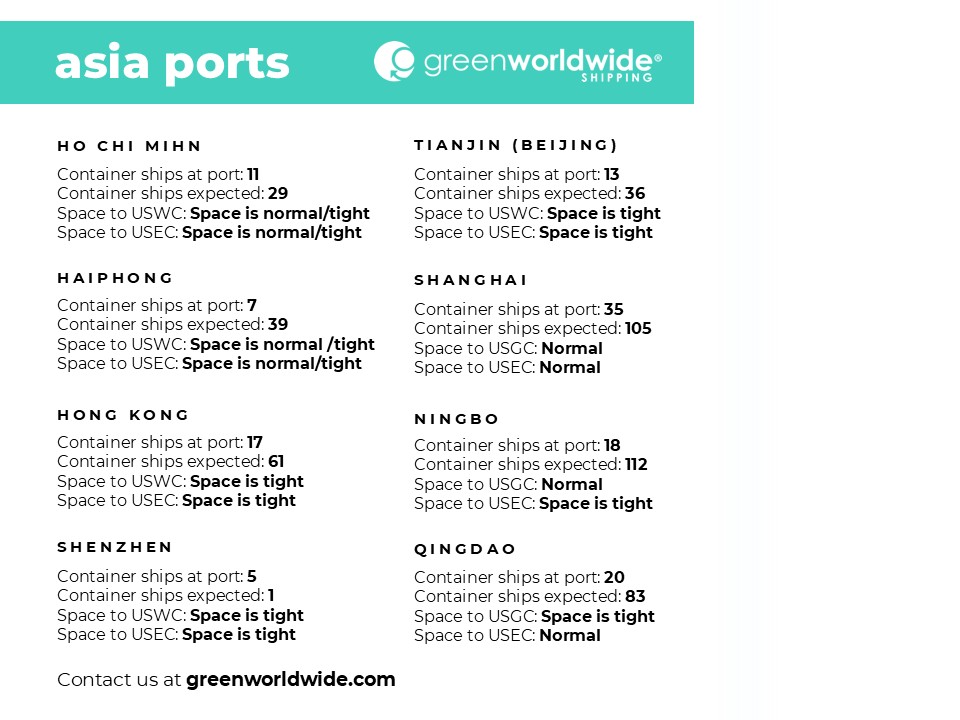
Congestion continues to affect vessel schedules across several major Chinese gateways following recent severe weather and accumulated schedule disruption.
Hapag-Lloyd reports average waiting times at Shanghai ranging from approximately 5 to 11 days, depending on vessel size and service. Ningbo waits remain approximately 3 to 6 days, while larger vessels calling Yantian are experiencing waits of approximately 3 to 4 days.
Carriers continue using port omissions, altered rotations and transshipment arrangements to recover schedules.
Importers with cargo moving through Shanghai, Ningbo or Yantian should continue monitoring upcoming departures and allow additional flexibility around vessel schedules and connecting services.
PANAMA CANAL REDUCES PANAMAX TRANSIT CAPACITY
The latest phase of the Panama Canal's temporary transit restrictions took effect September 15, reducing daily Panamax availability from 25 to 23 slots. Neopanamax capacity remains limited to nine daily slots.
The restrictions were introduced in response to below expected precipitation in the Canal watershed. The Panama Canal has also adjusted its daily auction process as part of its efforts to manage available capacity.
Importantly, the Canal has now postponed until further notice a previously planned reduction in the maximum authorized Neopanamax draft from 48 feet to 47.5 feet. The current 48-foot maximum draft remains in place.
Vessels arriving without confirmed reservations may experience longer waits under the reduced daily capacity. Shippers using Panama-dependent routings should continue monitoring confirmed reservations and vessel schedules.
GERMAN PORT LABOR NEGOTIATIONS REMAIN UNRESOLVED
Labor uncertainty remains at German ports following strike activity earlier this month.
The latest employer offer has been rejected by union members, and a primary union vote is scheduled to run from September 18 through October 1.
A 75% rejection threshold is required for the negotiation round to be declared unsuccessful. If that threshold is reached, the union may move toward indefinite strike action.
At this stage, no additional strike action has been announced.
Importers with cargo moving through German ports should continue monitoring labor developments and vessel schedules while negotiations remain unresolved.
GEMINI EXPANDS RETURN TO SUEZ ROUTING
Maersk and Hapag-Lloyd announced that four additional Gemini services will transition from Cape of Good Hope routing to the Suez Canal and Red Sea corridor.
The affected services are AE5, AE11, AE12 and ME2, covering Asia–Northern Europe, Asia–Mediterranean and India–Europe trades. They join AE15 and AE19, which were already operating through Suez.
Initial westbound transitions begin September 19, with additional changes scheduled throughout September and October. The first AE12 sailing has not yet been announced.
Routing through Suez offers shorter transit times than sailing around the Cape of Good Hope, but Maersk and Hapag-Lloyd continue to state that future service changes remain dependent on regional security conditions.
Shippers should continue reviewing individual service routings rather than assuming a broader network-wide return to Suez.
AIR CARGO PRICING HOLDS DESPITE SOFTER WEEKLY VOLUMES
Global air cargo volumes declined 1% week over week in Week 36, while worldwide capacity also decreased approximately 1%.
Spot rates from Asia Pacific increased 2% to the United States and 3% to Europe. Compared with the same period last year, Asia Pacific–Europe pricing was 15% higher, while Asia Pacific–U.S. rates were approximately 40% higher.
Global air cargo tonnage remained 7% above the same week last year, although conditions continue to vary significantly by individual trade lane.
Shippers using air freight should continue evaluating capacity and pricing by origin and destination rather than relying on broader global market trends.
REGULATORY UPDATE: SECTION 338 CHANGES TAKE EFFECT
Changes to the scope of U.S. Section 338 measures on certain Canadian-origin products took effect September 15.
The September 8 actions modify the products covered by the existing 50% additional duties, removing certain products from the tariff scope while adding others. The measures apply to covered goods regardless of USMCA qualification and are applied in addition to applicable Section 232 duties.
A separate phase takes effect September 29, when certain Canadian products identified in the applicable proclamations will be excluded from importation into the United States rather than remaining subject to the additional Section 338 duties.
Products subject to the upcoming import prohibition that were imported before September 29 but not yet entered for consumption or withdrawn from warehouse will remain subject to the existing 50% additional duty.
Importers of affected Canadian-origin goods should review product classifications, shipment timing and applicable Section 338 treatment before cargo moves.
Stay up-to-date on freight news with Green’s Weekly Freight Market Update by following us on LinkedIn. For continuous updates, make sure to check out our website at greenworldwide.com.